Lightweight Anomaly Detection in WBANs with One-Class SVM
Shreea Bose* and Chittaranjan Hota
Department of Computer Science and Information Systems, BITS Pilani, Hyderabad Campus, India
E-mail: p20240026@hyderabad.bits-pilani.ac.in; hota@hyderabad.bits-pilani.ac.in
*Corresponding Author
Manuscript received 15 March 2025, accepted 14 July 2025, and ready for publication 15 August 2025.
© 2025 River Publishers
Abstract
Wearable and implanted devices are revolutionizing healthcare through WBANs, enabling real-time, remote monitoring of physiological indicators. However, issues such as sensor malfunctioning, external interference, or cyberattacks on these miniature devices can compromise the effectiveness of these systems, making reliability a critical concern. These sensor failures may result in inaccurate readings, known as anomalies, which, if improperly interpreted, may pose a major risk to a healthcare application using these parameters. This study investigates machine learning techniques for detecting anomalies in WBANs, focusing on One-Class Support Vector Machines (One-Class SVM). We assess the performance of One-Class SVM alongside other advanced anomaly detection methods, including Logistic Regression, Elliptic Envelope, SGD One-Class SVM, and Isolation Forest. For our evaluations, we used a large dataset from the SmartNet AI Lab, encompassing a wide range of WBAN scenarios. The results indicate that One-Class SVM outperforms the other models, achieving an accuracy of 98.52%, and a precision of 99.98%. Unlike the other models, One-Class SVM balances computational efficiency and anomaly detection accuracy, making it ideal for resource-constrained WBANs. By utilizing less power for training and inference, One-Class SVM enhances the energy efficiency of WBANs.
Keywords: Anomaly detection, energy efficient, WBANs, informative healthcare, one-class SVM.
1 Introduction
Wireless Body Area Networks (WBANs) consist of small, low-power sensors that collect and transmit essential health data, including heart rate, blood pressure, and oxygen saturation. They have transformed the healthcare sector by allowing continuous and real-time monitoring of patient’s physiological conditions through wearable and implantable devices. This advancement has greatly enhanced chronic disease management, remote health monitoring, and personalized medicine, leading to better patient healthcare outcomes and reducing the burden on traditional healthcare systems. WBANs face several challenges, including energy efficiency, anomaly detection, and reliable operation in resource-constrained environments. Issues such as sensor malfunctioning, external interference, or cyberattacks on these miniature devices can compromise the performance of these systems, making reliability a critical concern. These sensor failures may result in inaccurate readings, known as anomalies, as shown in Figure 1, which, if misinterpreted, may pose a major risk to a healthcare application using these bio-markers.
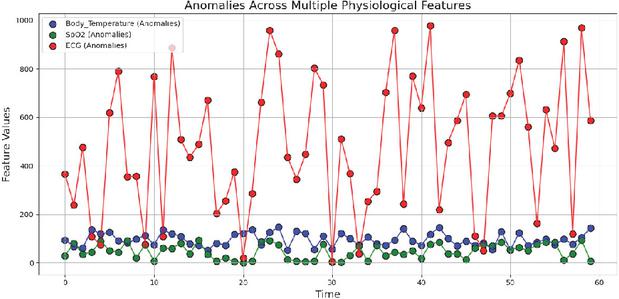
Figure 1
Plot of Anomalies across various physiological parameters.
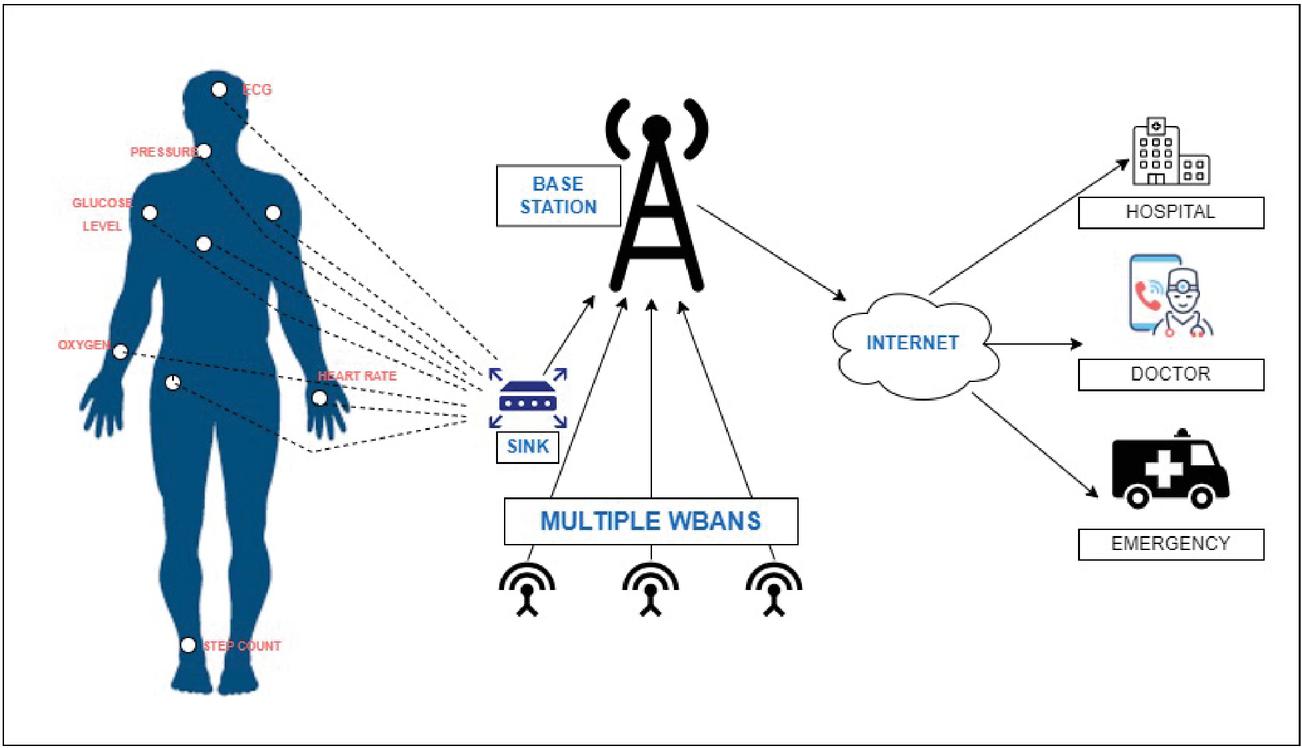
Figure 2
The Network Model of WBANs working and sending essential data.
In practical WBAN applications, conventional anomaly detection methods may not be feasible due to their high computational demands or the need for labeled datasets. This study addresses this gap by exploring the use of one-class support vector machines (One-class SVM) for anomaly detection in WBANs. The One-Class SVM is first trained with data collected from regular sensor operations in WBANs to ensure the proposed model works effectively. Once trained, the model evaluates new data to determine if it significantly deviates from the learned normal behavior and can be classified as an anomaly. Figure 2. illustrates how the WBAN Network Model operates. Data from the sensors is gathered by the sink and transmitted to the base station. Multiple WBAN’s data are gathered, and anomaly detection is carried out at the base station. The appropriate emergency services are notified if there is a major health concern. This study evaluates how effective One-Class SVM is compared to popular anomaly detection methods, including Logistic Regression, Elliptic Envelope, SGD One-Class SVM, and Isolation Forest. The findings indicate that One-Class SVM outperforms these models in metrics like, F1-score, recall, accuracy, and precision, all while maintaining energy efficiency. Its ability to process data effectively with minimal resource usage ensures reliability and sustainability in WBAN systems, aligning perfectly with the principles of green health. This research lays the foundation for sustainable and energy-efficient healthcare solutions by integrating advanced machine learning algorithms with green health initiatives. The results suggest that One-Class SVM could serve as a reliable approach for detecting anomalies in WBANs, paving the way for future sustainable and environmentally friendly healthcare systems.
2 Related Works
The study [1] presented a two-tier approach for efficient health monitoring in WBANs. The two-tier method reduces cloud transmission, latency, and power consumption by detecting anomalies locally at the LPU and discarding up to 90% of redundant health data for energy savings. [2, 3] state the use of Clustering Models, K-Means with DBSCAN and SMO, and how anomalies can be detected. The models, however, encountered parameter selection and performance constraints. In [4], the study provides a Markov Model-based approach for detecting anomalies in WBANs. A single-variate time series is used to discover anomalies by calculating the root mean square error (RMSE) between projected and actual values. The study [5] used Physionet data to suggest an SVM-based anomaly detection model; however, it was limited in its capacity to adapt to dynamic settings due to its reliance on static thresholds. [6] introduced a Logarithmic Kernel Function (LKF) for SVMs for better regression, providing better performance than conventional kernels. Our model is focused on reduced power consumption and performs fairly better than the models discussed.
3 Dataset and Proposed Model
3.1 Dataset
The dataset of 72,000 rows used for anomaly detection in WBANs was collected from 16 individuals over five days in a controlled lab environment (SmartNet AI Lab). Data collection involved three sessions of five minutes each, yielding 300 rows for each participant per session. This dataset is divided into two primary categories: four individuals identified as patients with abnormal physiological patterns and twelve individuals classified as normal. A set of real-time sensors to record vital physiological parameters was used to gather the data. While the MAX30102 [7] sensor tracked pulse rate and blood oxygen saturation () levels, the MLX90614 [8] sensor was used to assess body temperature. The ECG AD8232 sensor recorded electrocardiogram (ECG) data, and the DFRobot heart rate sensor measured additional heart rate readings. These sensors enable continuous observation of people in real time by integrating them into an Arduino-based system. The sensors in the SmartNet AI Lab, BITS Pilani, Hyderabad, were arranged in the experimental setup for data gathering, which is shown in Figure 3. The testbed was made to function in a controlled, consistent environment, guaranteeing the collection of high-quality data. The sensors were arranged strategically to maximize physiological monitoring accuracy and consistency, improving the data’s durability and dependability.
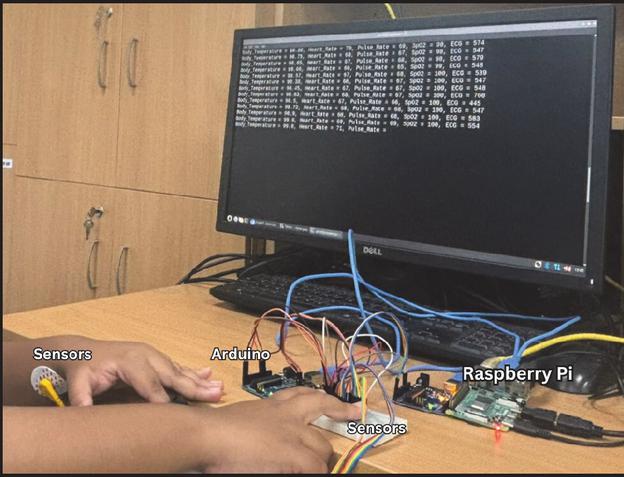
Figure 3
The IoT testbed setup at SmartNet AI Lab, BITS Pilani, Hyderabad.
3.2 Working Model
The One-Class SVM Anomaly Detection Algorithm learns the distribution of normal samples to detect abnormalities in physiological data . To provide consistent scaling, the feature vectors are first normalized during preprocessing. Normal samples are extracted during the training phase, and a One-Class SVM model is fitted using a predetermined objective function that minimizes the weight vector’s norm while guaranteeing that most data points fall inside a decision boundary. Accuracy is calculated in the last evaluation phase by comparing predicted labels with ground truth values.
Algorithm 1 One-class SVM anomaly detection
1: Input: Dataset
2: (feature vector)
3: (evaluation labels: normal, anomaly)
4: Preprocessing: = StandardScaler
5: Training:
6: Extract normal samples:
7: Optimization:
8:
9: subject to:
10: for all each do
11: Compute decision function
12: if then
13: Normal
14: else
15: Anomaly
16: end if
17: end for
18: Accuracy:
19: return and Accuracy
One-Class SVM aims to find a hyperplane that separates most of the data points from the origin in a high-dimensional feature space as defined in Equations (1) and (2). Here is the normal vector of the decision boundary. represents the mapping of input data into a higher-dimensional space. is the threshold that defines the separating hyperplane. are slack variables allowing for some margin violations. is a user-defined parameter controlling the proportion of outliers. This formulation ensures that most of the data points lie on one side of the hyperplane while identifying anomalies as outliers.
| (1) | |
| (2) |
4 Experimental Results
One Class SVM is a lightweight machine learning model with improved accuracy, CPU utilization, and energy consumption. It has demonstrated better results in terms of precision, recall, and accuracy when compared to other lightweight models, like Logistic Regression, Elliptic Envelope, SGD One-Class SVM, and Isolation Forest. To display the power consumption and energy efficiency, we have compared it with various deep learning algorithms. We detect this anomaly in the base station, which may be a laptop, a mobile device, or even a Raspberry Pi. Therefore, energy should always be conserved, regardless of the type of base station, and One-Class SVM has been found to achieve this objective.
4.1 Data Preprocessing
A StandardScaler standardizes the raw data, normalizing physiological characteristics like body temperature, heart rate, pulse rate, , and ECG signals. This ensures that features with different units and scales don’t influence the anomaly detection model. Plots are then created to illustrate the detected anomalies, with anomalies represented as scatter dots and normal data shown as a continuous line in Figure 4.
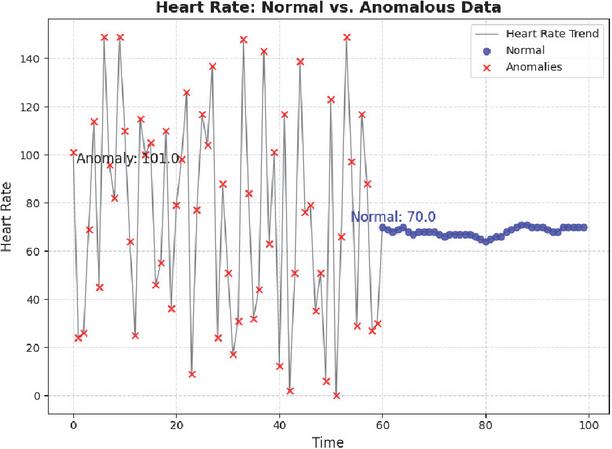
Figure 4
A plot to show the normal vs anomaly readings of physiological parameter HeartRate.
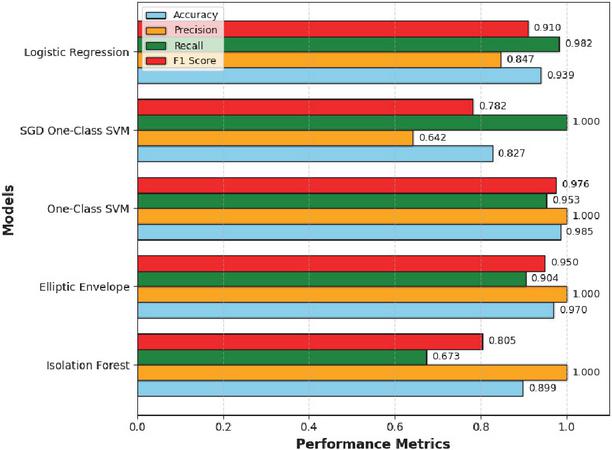
Figure 5
Comparision of various lightweight ML models.
4.2 Comparitive Results
One-Class SVM stands out among other models for anomaly detection due to its effective balance between recall and precision, as shown in Figure 5. It has an impressive accuracy rate of 98.52%, a precision rate of 99.98%, and a recall rate of 95.25%, allowing it to identify abnormalities while minimizing false positives. Unlike Isolation Forest and Elliptic Envelope, which struggle with recall, One-Class SVM maintains strong detection capabilities. It also surpasses SGD One-Class SVM and Logistic Regression, which show lower accuracy, as shown in Figure 6. Its ability to model complex decision boundaries makes it better for reliable and efficient anomaly detection in high-dimensional data.
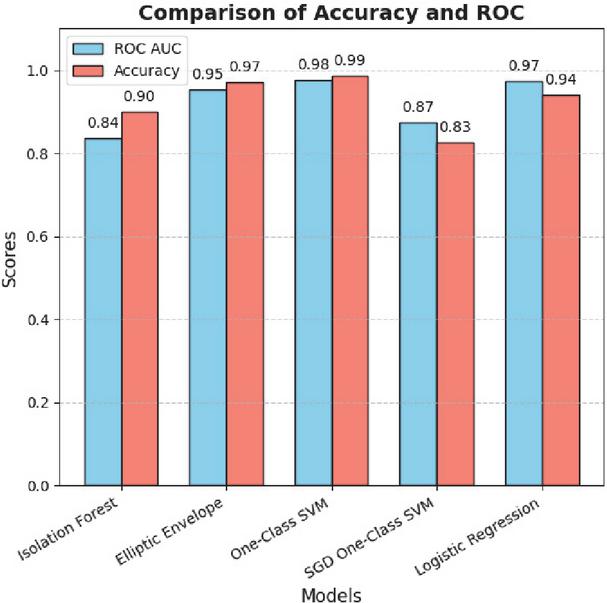
Figure 6
Accuracy and ROC of one-class SVM and ML models.
Table 1
| One-class SVM hyperparameter tuning results | |||||
| Kernel | Accuracy | Precision | Recall | F1 Score | |
| linear | 0.01 | 0.572 | 0.409 | 0.857 | 0.554 |
| linear | 0.05 | 0.477 | 0.202 | 0.233 | 0.216 |
| linear | 0.10 | 0.590 | 0.416 | 0.804 | 0.549 |
| linear | 0.20 | 0.462 | 0.202 | 0.248 | 0.222 |
| poly | 0.01 | 0.783 | 0.593 | 0.960 | 0.733 |
| poly | 0.05 | 0.774 | 0.582 | 0.965 | 0.726 |
| poly | 0.10 | 0.732 | 0.539 | 0.944 | 0.686 |
| poly | 0.20 | 0.710 | 0.520 | 0.865 | 0.649 |
| rbf | 0.01 | 0.996 | 0.999 | 0.988 | 0.994 |
| rbf | 0.05 | 0.985 | 0.999 | 0.952 | 0.975 |
| rbf | 0.10 | 0.969 | 0.999 | 0.902 | 0.948 |
| rbf | 0.20 | 0.939 | 0.999 | 0.803 | 0.891 |
| sigmoid | 0.01 | 0.704 | 0.512 | 0.990 | 0.675 |
| sigmoid | 0.05 | 0.686 | 0.497 | 0.955 | 0.654 |
| sigmoid | 0.10 | 0.339 | 0.308 | 0.904 | 0.459 |
| sigmoid | 0.20 | 0.312 | 0.284 | 0.803 | 0.420 |
Table 2
| Comparison of anomaly detection models | ||||
| Model | Accuracy | Precision | Recall | F1 Score |
| OC SVM | 0.9715 | 1.0000 | 0.9525 | 0.9757 |
| ANN | 0.9997 | 0.9995 | 1.0000 | 0.9997 |
| CNN | 0.9998 | 0.9996 | 1.0000 | 0.9998 |
| LSTM | 0.9997 | 0.9995 | 1.0000 | 0.9997 |
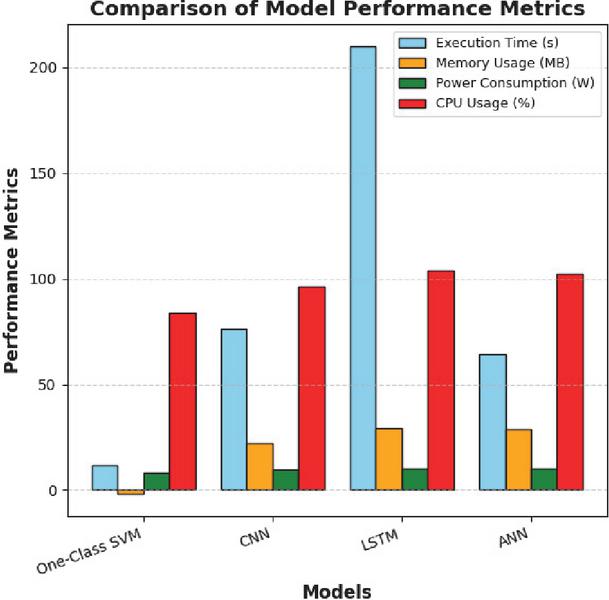
Figure 7
Comparision of one-class SVM with deep learning algorithms.
Table 2 shows the hyperparameter tuning performed using various kernels of One-Class SVM to find the best results. The results show that the RBF kernel performs the best when is 0.01 having an accuracy of 99.6%, precision of 99.9%, recall of 98.8% and F1 Score of 99.4%. One-Class SVM is a lightweight algorithm as it is a highly effective anomaly detection technique compared to CNN, LSTM, and ANN. Figure 7 shows that the fastest execution time (11.96s) and the lowest memory usage (-1.72MB) surpass deep learning models that require significant processing power. Additionally, it is more energy-efficient than CNN, LSTM, and ANN, with lower power consumption (8.38W) and CPU usage (83.8%). Table 2 compares our model with deep learning models on accuracy, precision, recall and F1 score. One‑Class SVM achieves 97.15% accuracy, close to the near‑perfect scores of ANN, CNN, and LSTM, despite its known sensitivity to kernel choice. By focusing on a minimal feature set and highly optimized inference, we drastically cut computational load and energy consumption compared to the deep models. While deep architectures edge out slightly in raw metrics, their intensive matrix operations and back‑propagation translate into much higher power draw, making our energy‑aware SVM approach more practical for always‑on WBAN monitoring.
5 Future Work
The concept of green health focuses on integrating environmentally friendly practices into healthcare, is marked by resource scarcity and climate change concerns [9, 10, 11]. Sustainability extends beyond energy efficiency to include long‑term resource consumption, device lifespan, and overall computational overhead [12]. Accordingly, future studies will integrate comprehensive life cycle assessments of WBAN deployments, quantifying the environmental impact of hardware manufacturing, maintenance, and end‑of‑life disposal. To address the One‑Class SVM’s sensitivity to evolving anomalies and its limited capacity for capturing complex spatio‑temporal dependencies, adaptive kernel strategies and hybrid SVM–deep‑learning frameworks will be explored. The study’s scope will be broadened by incorporating larger, more heterogeneous datasets—including clinical repositories such as MIMIC‑IV [13] to validate generalizability across varied demographics and physiological conditions. Through these efforts, the expanded evaluation framework will rigorously revisit sustainability metrics and model robustness, paving the way for greener, more resilient digital‑health monitoring solutions.
6 Conclusion
The One-Class SVM has proven to be a highly effective model for detecting anomalies, offering low execution time, minimal memory usage, and reduced power consumption, all while achieving impressive accuracy, precision, and recall. Compared to other models like CNN, LSTM, and ANN, One-Class SVM is much lighter on computational resources, making it ideal for real-time health monitoring in resource-constrained environments. This efficiency is particularly beneficial for sustainable green healthcare, where reducing energy consumption and computing costs is crucial. By integrating One-Class SVM with WBANs, healthcare systems can reduce unnecessary hospital stays, minimize medical waste, and lower carbon emissions associated with traditional in-person healthcare services. This approach promotes a patient-centered, cost-effective, and energy-efficient health monitoring method. One-Class SVM does have some limitations. It tends to struggle with identifying unknown or evolving anomalies because it primarily depends on clearly defined normal data for training. Additionally, it can face challenges with highly unbalanced datasets and is sensitive to the choice of parameters. Despite these issues, its versatility and low resource requirements make it a valuable tool for creating intelligent, eco-friendly, and sustainable healthcare solutions.
References
[1] S. Jain, P. Jain, P. Upadhyay, J. Moualeu, and A. Srivastava, “An energy efficient health monitoring approach with Wireless Body Area Networks,” ACM Transactions on Computing for Healthcare, vol. 3, no. 3, p. 1–-22, Apr 2022.
[2] S. Gadal, R. Mokhtar, M. Abdelhaq, R. Alsaqour, E. S. Ali, and R. Saeed, “Machine Learning-Based Anomaly Detection Using K-Mean Array and Sequential Minimal Optimization,” Electronics, vol. 11, no. 14, 2022.
[3] U. Rashid, M. F. Saleem, S. Rasool, A. Abdullah, H. Mustafa, and A. Iqbal, “Anomaly Detection using Clustering (K-Means with DBSCAN) and SMO,” Journal of Computing and Biomedical Informatics, vol. 7, no. 02, Sep. 2024.
[4] M. U. Harun Al Rasyid, I. U. Nadhori, I. Syarif, I. Winarno, F. Furoida, and A. Amrullah, “Anomaly Detection in Wireless Body Area Network using Mahalanobis Distance and Sequential Minimal Optimization Regression,” in 2021 International Seminar on Application for Technology of Information and Communication (iSemantic), pp. 64–69, 2021.
[5] O. Salem, A. Guerassimov, A. Mehaoua, A. Marcus, and B. Furht, “Anomaly detection in medical wireless sensor networks using SVM and linear regression models,” Int. J. E-health Med. Commun., vol. 5, no. 1, pp. 20–45, Jan. 2014.
[6] B. Hicdurmaz, N. Calik, and S. Ustebay, “Gauss-like Logarithmic Kernel Function to improve the performance of kernel machines on the small datasets,” Pattern Recognition Letters, vol. 179, pp. 178–184, 2024.
[7] E. Lodi, R. Verma, and M. M. Malto, “This project report describes the design and implementation,” Zenodo, 6 2023.
[8] G. Jin, X. Zhang, W. Fan, Y. Liu, and P. He, “Design of Non-Contact Infra-Red Thermometer Based on the Sensor of MLX90614,” The Open Automation and Control Systems Journal, vol. 7, no. 1, pp. 8–20, 2 2015.
[9] P. K. Bishoyi and S. Misra, “Enabling Green Mobile-Edge Computing for 5G-Based Healthcare Applications,” IEEE Transactions on Green Communications and Networking, vol. 5, no. 3, pp. 1623–1631, 2021.
[10] S. Chaudhary, A. Agarwal, D. Mishra, and S. Shah, ‘‘A review on green communication for wearable and implantable wireless body area networks,” Computer Networks, vol. 252, p. 110693, 2024.
[11] M. E. Sijm-Eeken, W. Arkenaar, M. W. Jaspers, and L. W. Peute, “Medical informatics and climate change: a framework for modeling green healthcare solutions,” Journal of the American Medical Informatics Association, vol. 29, no. 12, pp. 2083–2088, 10 2022.
[12] M. Sehgal and S. Goyal, “Intelligent Hybrid Model for Energy-Efficiency on WBAN,” pp. 380–384, 2023 International Conference on Advanced Computing and Communication Technologies (ICACCTech), IEEE, 12 2023.
[13] A. Johnson, L. Bulgarelli, T. Pollard, B. Gow, B. Moody, S. Horng, L. A. Celi, and R. Mark, “MIMIC-IV,” 2024.
Biographies

Shreea Bose is a full-time Ph.D. candidate in the Department of Computer Science and Information Systems at BITS Pilani, Hyderabad Campus, under the supervision of Professor Chittaranjan Hota. She has graduated with a Master’s degree in Computer Science from St. Xavier’s College, Kolkata, and has passed the GATE and UGC exams for Computer Science. She is also working with MindMap Consultancy in Hyderabad as a Project Associate in the area of Generative AI. Her research interest focuses in Digital Health, Data Science, and Machine Learning. Her current area of research work is on Anomaly detection in Wireless Body Area Network (WBAN).

Chittaranjan Hota is a Senior Professor of Computer Science at BITS Pilani, Hyderabad, with 35 years of experience in teaching, research, and academic leadership. He holds a PhD from BITS Pilani and has over 150 publications, supervising 18+ PhD students. His research spans Big Data Analytics, Cybersecurity, and Machine Learning, with a focus on secure Bio-Cyber-Physical Systems under India’s National Mission on Cyber-Physical Systems. He has held key administrative roles, including Associate Dean of Admissions and founding Head of the Computer Science Department at BITS Hyderabad. He has led multiple government and industry-funded projects on network security, code tamper-proofing, smart healthcare, and cognitive IoT. He has held visiting positions at leading global universities and received prestigious awards, including the Australian Vice Chancellors Award and two Erasmus Mundus Fellowships. He is a Senior Member of IEEE.
Wireless World Research and Trends, Vol. 2, Issue 1, 29–34.
DOI. No. 10.13052/2794-7254.018
© 2025 River Publishers