Design and Analysis of Millimeter-wave Antenna for New Radio (NR) 5G Bands Supporting a Green Wireless Future
Moustafa M. Nasralla1,*, Mehr E. Munir1, Haleem Farman1 and Nikumani Choudhury2
1Smart Systems Engineering Laboratory, Department of Communications and Networks Engineering, College of Engineering, Prince Sultan University, PO BOX 66833, Riyadh, 11586, Saudi Arabia
2Department of Electrical and Computer Engineering, Birla Institute of Technology and Science, Pilani, Hyderabad Campus, Hyderabad 500078, India
E-mail: mnasralla@psu.edu.sa; mmunir@psu.edu.sa; hfarman@psu.edu.sa; nikumani@hyderabad.bits-pilani.ac.in
*Corresponding Author
Manuscript received 05 April 2025, accepted 14 July 2025, and ready for publication 15 August 2025.
© 2025 River Publishers
Abstract
Millimeter-wave (mmWave) fifth-generation (5G) networks play a pivotal role in advancing point-to-point communication and connectivity by leveraging cutting-edge 5G technology. These networks enable high-speed data transfer, low latency, and reliable wireless communication, making them essential for a wide range of 5G applications and services, while contributing to a green wireless future through efficient and sustainable designs. The proposed mmWave Multiple-Input-Multiple-Output (MIMO) antenna is a compact and lightweight solution specifically designed for seamless integration into 5G networks and other mmWave devices. Operating across a wide frequency range of 24–34 GHz, it offers an impressive impedance bandwidth of 10 GHz, effectively covering key New Radio (NR) 5G bands, including n257 (26.50–29.50 GHz), n258 (24.25–27.50 GHz), and n261 (27.50–28.35 GHz). With dimensions of just 25 10 mm, the antenna is fabricated on an RO4350B substrate with a thickness of 0.51 mm, ensuring a compact footprint suitable for modern applications. It delivers exceptional performance, achieving a peak efficiency of over 94% and gains of 5.35 dBi at 26 GHz, 6.4 dBi at 28 GHz, and 5.0 dBi at 32 GHz. The fabricated prototype closely matches simulation results, demonstrating its suitability for NR 5G frequency bands while aligning with the goals of a green wireless future. By enhancing energy efficiency, minimizing material usage in fabrication and reducing network power consumption, this research directly contributes to the development of a sustainable 5G ecosystem, supporting global efforts to achieve environmentally responsible wireless technologies.
Keywords: Millimeter-wave antenna, new radio 5G band, n257, n258, n261, energy efficiency, and sustainability.
1 Introduction
Millimeter-wave (mmWave) antennas are integral to achieving the high data rates and ultra-low latency required for 5G applications. Operating at frequencies above 24 GHz, they offer substantial bandwidth, enabling the seamless transmission of large data volumes. Due to the shorter wavelengths at mmWave frequencies, advanced antenna arrays and beamforming techniques are crucial for mitigating propagation challenges and ensuring reliable connectivity in dense urban 5G environments [1]. As a key enabler of 5G networks, mmWave antennas provide significantly greater bandwidth capacity than traditional cellular frequencies, making them ideal for high-demand applications such as virtual reality (VR), augmented reality (AR), autonomous vehicles, and the Internet of Things (IoT) [2]. Globally, 123 operators across 42 countries, including the USA, Europe, South Korea, Japan, and China, are actively investing in 5G technologies through trials, licensing, deployments, and operational networks. These efforts primarily target the 24.25–29.5 GHz spectrum, a crucial band for 5G service development. The n257 band (26.5–29.5 GHz), extensively utilized in Japan, North America, and South Korea, has been rigorously tested and plays a pivotal role in the 5G mmWave spectrum, serving as a capacity layer for short-range, high-speed transmissions. In Europe and China, the n258 band (24.25–27.5 GHz) is a key mmWave allocation that has undergone significant testing for widespread adoption. At the upper end of the spectrum, the n261 band (28 GHz), spanning 27.5–28.35 GHz, is the highest frequency band in the 5G ecosystem. It is often deployed alongside the n260 band (39 GHz) to enhance short-range, high-data-rate transmissions, which are fundamental to mmWave technology [3].
2 Related Work
The mmWave antennas in 5G applications are developed using methodologies like microstrip-fed slot, defected ground structure (DGS), electromagnetic band gap (EBG), and substrate-integrated waveguide (SIW) techniques. Choosing a design approach depends on the application’s particular needs and comes with its unique set of advantages and drawbacks like antenna size, efficiency, beam steering capabilities, and impedance bandwidth. The authors in [4] propose a four-element linear array mmWave 5G cellular antenna operating in the 28 GHz band. The antenna features a vertically stacked configuration, utilizing a multilayer printed circuit board (PCB) via holes to enhance bandwidth and efficiency. However, including the spacers (i.e. via holes) add complexity to the design and testing process. The operating frequency of the linear array is 26.3 to 29.75 GHz, with a narrow impedance bandwidth of 3.72 GHz, which is unsuitable for practical 5G mmWave applications. The authors in [5] presented a broadband four-element mmWave antenna designed for 5G mmWave applications. The antenna operates within the frequency range of 23–30.5 GHz, with a total antenna size of 26 5 1.524 mm. Furthermore, to enhance impedance matching (for broad bandwidth) and isolation levels, four sets of 2 3 parasitic square array patches are integrated into the proposed 1 4 antenna array. However, the total efficiency exceeds 68%, making it unsuitable for practical 5G devices like smartphones.
The authors in [6] designed a mmWave four-element Vivaldi antenna array for 5G communication, operating across LTE low band (700–960 MHz, 1710–2690 MHz) and high band (25–30 GHz). The antenna exhibits broad performance capabilities, featuring an impedance bandwidth of 5 GHz and achieving a total efficiency exceeding 60%, which is relatively low for practical mmWave devices. An eight-element mmWave phased array antenna, designed for 28 GHz 5G applications, incorporates two sets of 1 8 back-cavity slot arrays positioned along the longer side edges of the metal cover to facilitate beam steering [7]. Operating within the 27.5–30 GHz frequency range, the antenna supports high-gain directional transmission. However, its limited impedance bandwidth of 2.5 GHz restricts its adaptability for practical mmWave 5G applications, where broader bandwidth is essential for enhanced data throughput and seamless connectivity. A substrate-integrated waveguide (SIW)-based mmWave antenna, developed for 5G mmWave applications, integrates two semi-circle patches and two suspended metal posts to enhance performance [8]. Operating within the 20.7–29.8 GHz frequency range, it achieves an impressive 9.1 GHz impedance bandwidth, ensuring broad-spectrum coverage. However, the intricate design and complex testing process present significant challenges, limiting its practicality for real-world 5G communication devices, where scalability, manufacturability, and ease of integration are critical.
The author in [9] designed the mmWave antenna to resonate specifically at 37.5 GHz, operating within the frequency range of 36.6-38.9 GHz with an impedance bandwidth of 2.3 GHz. However, the results of the fabricated model are not discussed, which does not validate the antenna performance for practical devices. The authors in [10] designed and developed a mmWave antenna operating at 28 GHz with an impedance bandwidth of 1.7 GHz, featuring a gain of 3.86 dBi and a total efficiency of 83%. However, the antenna’s gain is low, and its bandwidth is very narrow, making it unsuitable for practical 5G devices.
The proposed mmWave MIMO antenna provides a compact, high-performance solution for 5G networks, with a wide frequency range (24–34 GHz), high efficiency (94%), high gains (5.0–6.4 dBi), and precise support for NR 5G bands, ensuring seamless integration into advanced communication systems.
3 MIMO Antenna Configuration
This research presents a compact, light-weight, wideband mmWave MIMO antenna designed for NR 5G bands, with overall dimensions of 25100.51 mm. The antenna possesses a simple structure that can be easily fabricated, tested, and integrated with mmWave devices. It is designed and simulated using Computer Simulation Technology (CST) 2022 using RO4350B substrate with a thickness of 0.5 mm. The proposed antenna incorporates two innovative techniques to enhance its performance. The Defective Patch Structure Technique (DPST), referred to as the front view and shown in Figure 1, significantly improves the antenna’s gain and efficiency, making it essential for long-range communication and addressing signal attenuation challenges at higher frequencies. Additionally, the Defective Ground Structure Technique (DGST), referred to as the back view and illustrated in Figure 2, enables wideband operation, which is crucial for supporting high data rate applications in mmWave communication systems.
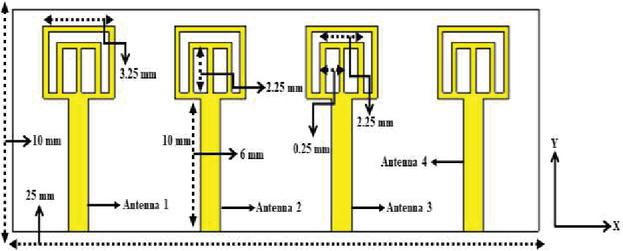
Figure 1
Front view (defective patch structure technique) of four element MIMO antenna.
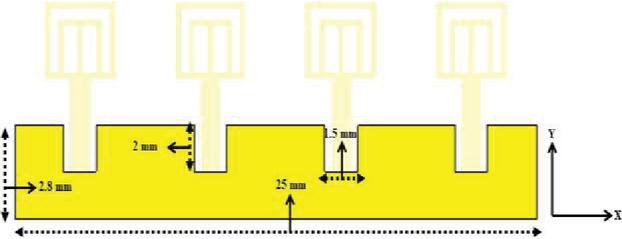
Figure 2
Back view (defective ground structure technique) of four element MIMO antenna.
4 Results and Discussions
The proposed MIMO antenna operates within the 24–34 GHz frequency band with an impedance bandwidth of 10 GHz. Additionally, the antenna covers the three NR 5G bands of n257, n258, and n261. The simulated response of the MIMO antenna, depicted in Figure 3, is suitable for future 5G networks. The port isolation of the four-element MIMO system, as shown in Figure 4, indicates an isolation of 21.1 dBi at 26 GHz and 32.5 dBi at 32 GHz.
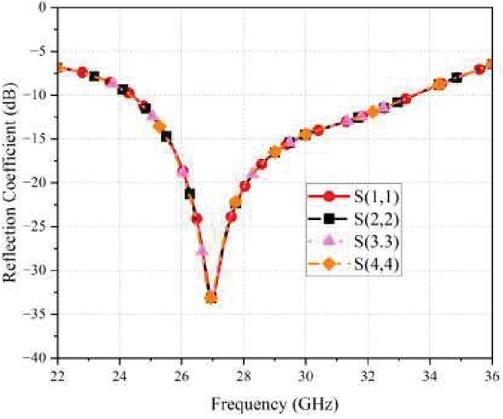
Figure 3
Reflection co-efficient of the proposed MIMO antenna.
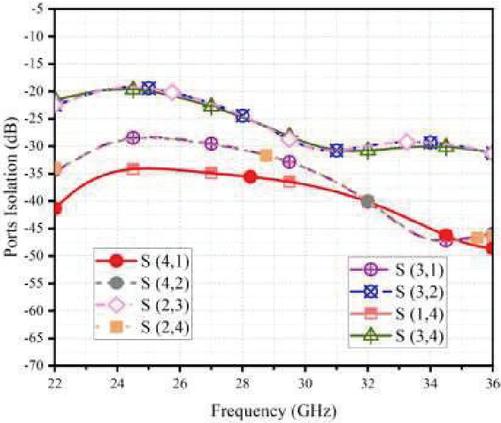
Figure 4
Ports isolation of the proposed MIMO antenna.
The MIMO antenna demonstrates good performance characteristics like gain, radiated efficiency, and total efficiency as shown in Figure 5. At 26 GHz, the antenna exhibits a gain of 5.35 dBi with a radiated efficiency of 96% and a total efficiency of 91%. Similarly, at 28 GHz, the antenna shows an increase of 6.4 dBi with a radiated efficiency of 95.85% and a total efficiency of 92.5%. Additionally, at 32 GHz, the antenna displays a gain of 5 dBi with a radiated efficiency of 95.45% and a total efficiency of 90.89%, making it suitable for NR 5G bands. The Figure 6 illustrates the fabricated prototype of four element MIMO antenna.
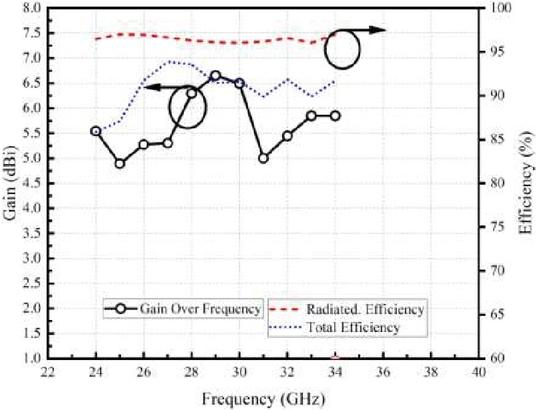
Figure 5
Gain, radiated and total efficiency of the proposed MIMO antenna.
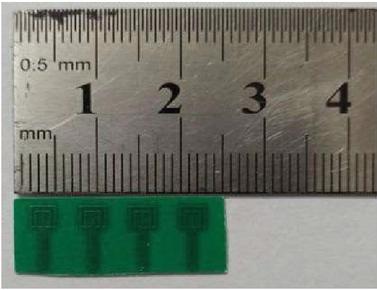
Figure 6
Fabricated prototype of the proposed MIMO antenna.
Figure 7 shows the simulated and measured reflection coefficient responses of the proposed four-element MIMO system. The solid black line represents the simulated data, while the solid red line represents the measured data. This illustrates a strong correlation between the simulated and measured results, suitable for sustainable 5G networks.
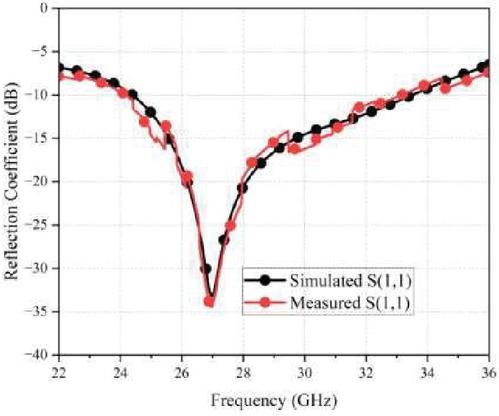
Figure 7
S11 simulated and measured reflection co-efficient.
The surface current at 28 GHz is illustrated in Figure 8, and it is noted that the surface current is enhanced due to DPST and DGST techniques. The current direction is primarily focused on the outer edges and the ground slot, circulating strong current among the radiating elements. Furthermore, the 3D gain at 28 GHz is shown in Figure 9, depicting the antenna radiation in a three-dimensional view.
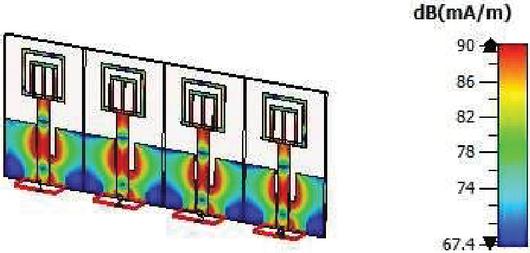
Figure 8
Surface current of MIMO antenna at 28 GHz.
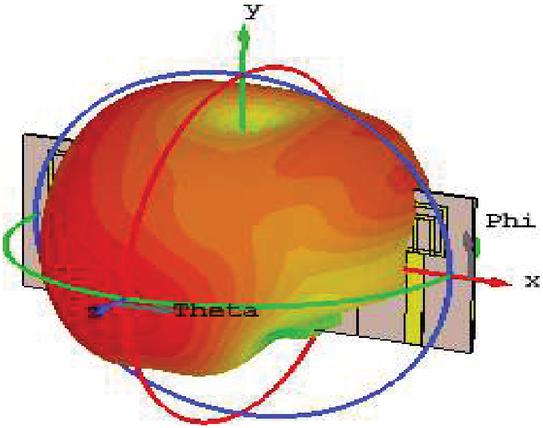
Figure 9
3D gain of MIMO antenna at 28 GHz.
The radiation patterns at 28 GHz for two planes, Phi (0) and Phi (90), are illustrated in Figures 10 and 11. The Phi (0) plane represents the zx axis of the antenna, with the main lobe direction at 0 and a 3 dB angular width of 83.5. The Phi (90) plane represents the xy axis of the antenna, with the main lobe slightly tilted to 356 and a side lobe level of 1.2 dB, showcasing their potential for practical NR 5G bands that promote a sustainable wireless future.
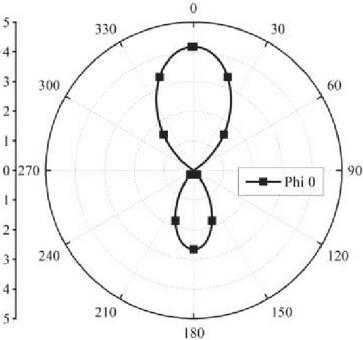
Figure 10
Radiation pattern phi (0) at 28 GHz.
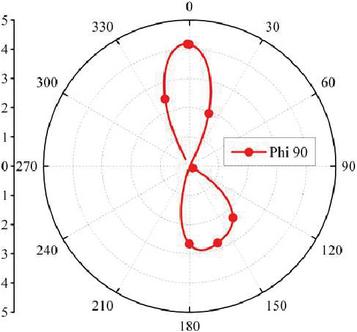
Figure 11
Radiation pattern phi (90) at 28 GHz.
The proposed mmWave MIMO antenna design supports a wide bandwidth of 10 GHz (24–34 GHz), enabling high data throughput essential for 5G FR2 performance. Based on the Shannon–Hartley theorem and real-world system modeling, the spectral efficiency is estimated using the following relation:
For a Line-of-Sight (LOS) condition in a Single-User MIMO (SU-MIMO) scenario with MIMO configuration and a moderate SNR of 15 dB, the achievable spectral efficiency is:
For Non-Line-of-Sight (NLOS) conditions under Multi-User MIMO (MU-MIMO) using beamforming, assuming an effective SNR of 10 dB and 2 parallel streams per user:
Therefore, the proposed antenna supports spectral efficiency values ranging from 6.9 to 20 bps/Hz, depending on the propagation scenario and MIMO mode. These performance metrics align with the typical requirements for 5G NR FR2 communication systems and validate the suitability of the proposed design for high-capacity mmWave deployments.
Most substrates (like RO4350B) have a temperature-dependent dielectric constant. This dependence is expressed as:
Where:
• : Dielectric constant at temperature
• : Dielectric constant at reference temperature (typically )
• : Temperature coefficient of dielectric constant (ppm/ or parts per million per )
For RO4350B, , or:
The resonant frequency of a microstrip antenna is inversely proportional to the square root of the dielectric constant:
So, an increase in due to temperature causes a decrease in resonant frequency:
Where:
For example, if:
Then:
And the fractional frequency shift:
So, for a center frequency of 28 GHz:
This is negligible in a wideband system (10 GHz bandwidth), proving thermal resilience. The antenna gain is affected by mismatch due to variation. Mathematically:
Where: : Radiation efficiency (can drop due to mismatch or added loss) D: Directivity Assuming small variation leads to mismatch (in return loss or VSWR), we estimate the gain drop as:
Let’s assume:
Then:
0.00208 dBi is extremely small value, which implies that even under thermal drift, the gain performance is stable.
5 Conclusion
The proposed mmWave MIMO antenna is compact and lightweight, operates across a broad frequency range of 24–34 GHz, with an impressive impedance bandwidth of 10 GHz. It covers essential NR 5G bands like n257, n258, and n261, contributing to a green wireless future by promoting efficient and sustainable communication technologies. With dimensions of 25 10 mm and boasting exceptional performance characteristics such as a peak efficiency exceeding 94% and gains of 5.35 dBi at 26 GHz, 6.4 dBi at 28 GHz, and 5.0 dBi at 32 GHz. The proposed antenna demonstrates strong alignment with simulation results, confirming its suitability for NR 5G frequency bands. The antenna’s design and fabrication process, incorporating the DPST and the DGST, ensures enhanced gain, efficiency, and wideband operation critical for optimizing communication over long distances and at higher frequencies. This research highlights the significance of the compact, wideband mmWave MIMO antenna in driving the evolution and efficiency of NR 5G networks, while aligning with the vision of a green wireless future.
Acknowledgment
The authors would like to acknowledge the support of Prince Sultan University in covering the conference expenses for this publication. This article is derived from a research grant funded by the Research, Development, and Innovation Authority (RDIA)-Kingdom of Saudi Arabia-with grant number (13292-psu-2023-PSNU-R-3-1-EF-).
References
[1] M. E. Munir, M. M. Nasralla and H. Farman, “Design and Development of Super-Compact Millimeter Wave Antenna for Future 5G Vehicular Applications,” 2024 IEEE 100th Vehicular Technology Conference (VTC2024-Fall), Washington, DC, USA, 2024, pp. 1–8, doi: 10.1109/VTC2024-Fall63153.2024.10757480.
[2] M. E. Munir, M. M. Nasralla and M. A. Esmail, “Design and Analysis of Super-Compact Millimeter Wave Antenna for 5G Vehicular Networks,” 2024 IEEE 99th Vehicular Technology Conference (VTC2024-Spring), Singapore, Singapore, 2024, pp. 1–8, doi: 10.1109/VTC2024-Spring62846.2024.10683396.
[3] https://www.5gmmwave.com/5g-mmwave-frequency-bands/5g-mmwave-band-n257-28ghz/.
[4] I.-J. Hwang, B. Ahn, S.-C. Chae, J.-W. Yu and W.-W. Lee, “Quasi-Yagi Antenna Array With Modified Folded Dipole Driver for mmWave 5G Cellular Devices,” in IEEE Antennas and Wireless Propagation Letters, vol. 18, no. 5, pp. 971–975, May 2019, doi: 10.1109/LAWP.2019.2906775.
[5] C.-Y.-D. Sim, J.-J. Lo and Z. N. Chen, “Design of a Broadband Millimeter-Wave Array Antenna for 5G Applications,” in IEEE Antennas and Wireless Propagation Letters, vol. 22, no. 5, pp. 1030–1034, May 2023, doi: 10.1109/LAWP.2022.3231358.
[6] J. Kurvinen, H. Kähkönen, A. Lehtovuori, J. Ala-Laurinaho and V. Viikari, “Co-Designed mm-Wave and LTE Handset Antennas,” in IEEE Transactions on Antennas and Propagation, vol. 67, no. 3, pp. 1545–1553, March 2019, doi: 10.1109/TAP.2018.2888823.
[7] B. Yu, K. Yang, C.-Y.-D. Sim and G. Yang, “A Novel 28 GHz Beam Steering Array for 5G Mobile Device With Metallic Casing Application,” in IEEE Transactions on Antennas and Propagation, vol. 66, no. 1, pp. 462–466, Jan. 2018, doi: 10.1109/TAP.2017.2772084.
[8] Y. Cheng and Y. Dong, “Wideband Circularly Polarized Planar Antenna Array for 5G Millimeter-Wave Applications,” in IEEE Transactions on Antennas and Propagation, vol. 69, no. 5, pp. 2615–2627, May 2021, doi: 10.1109/TAP.2020.3028213.
[9] Saraereh, O. A. (2022). Design and Analysis of Novel Antenna for Millimeter-Wave Communication. Computer Systems Science & Engineering, 43(1), doi: 10.32604/csse.2022.024202.
[10] Hussain, R., Alreshaid, A. T., Podilchak, S. K., and Sharawi, M. S. (2017). Compact 4G MIMO antenna integrated with a 5G array for current and future mobile handsets. IET Microwaves, Antennas & Propagation, 11(2), 271–279.
Biographies

Moustafa M. Nasralla (SM’21) received the B.Sc. degree (Hons.) in electrical engineering from Hashemite University, Jordan, in 2010, the M.Sc. degree in networking and data communications from Kingston University, London, U.K., in 2011, and the Ph.D. degree from the Faculty of Science, Engineering and Computing (SEC), Kingston University, London, U.K., in 2015. He is currently an Associate Professor and Chairman of the Department of Communications and Networks Engineering, Prince Sultan University (PSU), Riyadh, Saudi Arabia. He is currently the leader of the Smart Systems Engineering Laboratory (SSEL) at PSU. He was a member of the Wireless Multimedia and Networking (WMN) Research Group at Kingston University. He served as an active reviewer and received several distinguished reviewer awards from reputable journals, such as IEEE Transactions on Wireless Communications, IEEE Transactions on Multimedia, IEEE Transactions on Vehicular Technology, Wireless Communications (Elsevier), and Computer Network (Elsevier). He has solid research contributions in the area of networks and data communications, which are proven with publications in reputable journals with ISI Thomson JCR. He has won several national and internationally funded projects, such as Intelli-Student for the British Council, 5G-enabled Smart City Development for RDIA in Saudi Arabia, U.K. Home Office, and EU FP7 CONCERTO. Currently, he is serving as a Guest Editor for Alexandria Engineering Journal (Elsevier), International Journal of Distributed Sensor Networks (SAGE), Journal of Communications and Networks (Frontiers), and an Organizer of the International Conference on Sustainability: Developments and Innovations, and the 5G-Enabled Smart Cities workshop in the IEEE International Conference on Smart Cities. Moreover, he is a Senior Member of IEEE, a member of IEEE ComSoc, and the Association of Computing Machinery (ACM). He has published over 100 articles in high-impact factor journals and reputable conferences. He is a fellow of the Higher Education Academy (FHEA). His research interests include the latest generation of wireless communication systems (e.g., 6G, 5G, LTE A, and LTE wireless networks), wireless sensor networks, network security, the Internet of Things (IoT), machine learning, radio resource allocation, telemedicine and video compression, and multimedia communications.

Mehr E. Munir received the B.Sc. degree (Hons.) in electrical engineering (telecommunication engineering) from the City University of Science and Information Technology (CUSIT), Peshawar, Pakistan, in 2014, and the M.Sc. and Ph.D. degrees in electrical engineering (communication and electronics) from Iqra National University (INU), Peshawar, in 2017 and 2023, respectively. He started his career in February 2015, as a Visiting Lecturer with the Electrical Engineering Department, CUSIT, after that he joined INU, in September 2015, as a Laboratory Engineer with the Electrical Engineering Department. In November 2018, due to his best performance and excellent research profile, he was promoted to the position of a Lecturer with the Electrical Engineering Department, INU. In January 2019, he was appointed as a Post Graduate Program Coordinator/Lecturer with the Electrical Engineering Department, INU, and on May 2019, he was appointed as the Senior Design Officer of the Aircraft Rebuilt Factory (ARF), Aviation Design Institute (AvDI), Pakistan Aeronautical Complex (PAC), Kamra, Pakistan. He is currently a Research Fellow with the Smart System Engineering Laboratory, College of Engineering, Prince Sultan University (PSU), Riyadh, Saudi Arabia. He has published more than 40 research articles in Clarivate Analytics (ESCI and SCI) international reputed journals, HEC approved journals, and several IEEE conference papers in and outside the country.

Haleem Farman (Senior Member, IEEE) received the master’s degree in electronics engineering from International Islamic University, Islamabad, Pakistan, in 2008, and the Ph.D. degree from the Department of Computer Science, University of Peshawar, Pakistan, in 2018. He is currently with the Smart Systems Engineering Laboratory, College of Engineering, Prince Sultan University (PSU), Riyadh, Saudi Arabia. He has published over 50 articles in high-impact factor journals and reputable conferences. His research interests include wireless sensor networks, the Internet of Things, smart cities, ad-hoc networks, intrusion detection and privacy preservation, and machine learning. He has served as a reviewer for several reputable journals and conferences. He has solid research contributions in ad-hoc networks, the Internet of Things, and deep learning. He has secured several funded research projects.

Nikumani Choudhury (S’14) received the B.Tech degree in information technology from the Assam University, India, in 2012, and the M.Tech. degree in information technology from Gauhati University in 2014. He is currently pursuing the Ph.D. degree with IIIT Guwahati, India. He was a Project Fellow at IIT Guwahati. His research interests include low power wireless networks and Internet of Things.
Wireless World Research and Trends, Vol. 2, Issue 1, 9–14.
DOI. No. 10.13052/2794-7254.015
© 2025 River Publishers