Reconfigurable OFDM Transceivers for UAVs: A Survey of Technologies and Design Strategies
V. C. Madhavi* and Subhendu Kumar Sahoo
Department of Electrical & Electronics Engineering, BITS-Pilani, Hyderabad Campus, Hyderabad-500078, India
E-mail: p20240069@hyderabad.bits-pilani.ac.in; sahoo@hyderabad.bits-pilani.ac.in
*Corresponding Author
Manuscript received 06 April 2025, accepted 28 November 2025, and ready for publication 31 December 2025.
© 2025 River Publishers
DOI. No. 10.13052/2794-7254.024
Abstract
Unmanned Aerial Vehicles (UAVs), commonly known as drones, are becoming an integral part of modern life. They are increasingly used in communication, surveillance, photography and filmmaking, military operations and commercial applications. As drones take on more diverse roles, their communication systems must be highly efficient, reliable, and flexible. One promising way to meet these demands is through Orthogonal Frequency Division Multiplexing (OFDM) transceivers. OFDM is a popular communication technology known for its ability to transmit data effectively, even in challenging environments such as cities or over long distances. It excels at mitigating signal interference caused by reflections (multipath propagation) and efficiently using the available frequency spectrum. These features make OFDM an excellent choice for drone communication. However, UAVs often need to operate across a variety of environments and support multiple communication standards, such as 5G, Wi-Fi, and IoT. This creates a need for transceivers that can adapt to these varied requirements. A reconfigurable OFDM transceiver addresses this need by supporting multiple communication standards and adjusting its parameters in real-time, enabling seamless communication across different networks. This is especially important for drones, as they frequently switch between tasks and environments. For instance, a drone may need high-speed connections for streaming video in one scenario and low-power connections for transmitting sensor data in another. This survey paper focuses on the design, development, and challenges associated with building multi-standard reconfigurable OFDM transceivers for drone applications. It reviews key technologies, recent advancements, and future possibilities.
Keywords: Adaptive wireless systems, drone networking, multi-standard transceiver, OFDM for UAVs, reconfigurable OFDM, UAV communication, 5G integration.
1 Introduction
Unmanned Aerial Vehicles (UAVs), commonly known as drones, are increasingly used in military, commercial, and industrial sectors. Their growing popularity is mainly due to their flexibility, mobility, and ability to access remote areas. To function efficiently, UAVs require reliable and high-speed communication systems that can handle fast movement, changing signal conditions, and interference [1, 2, 3]. Orthogonal Frequency Division Multiplexing (OFDM) is one of the most widely adopted modulation techniques in modern wireless communication systems. It offers high spectral efficiency and strong resistance to multipath fading, which makes it well-suited for UAV-based applications [4, 5, 6, 7, 8]. However, UAVs often need to operate in dynamic and diverse environments where different wireless standards such as Wi-Fi, LTE, 5G, and future 6G networks are used [9, 10, 11]. This diversity presents a challenge for maintaining consistent and reliable communication links. To overcome this, a reconfigurable OFDM transceiver can be employed. Such a transceiver can adjust its parameters, such as subcarrier spacing, modulation scheme, and coding rate, based on the operating conditions and the required wireless standard [4, 5, 12]. This adaptability ensures better connectivity, reduced latency, and improved communication quality, even in highly dynamic scenarios. Recent research has also explored additional enhancements such as integration with MIMO, NOMA, and mmWave technologies [1, 7, 13, 14], and the use of intelligent algorithms like machine learning to optimize performance [2, 6, 10, 15]. Moreover, newer methods such as Reconfigurable Intelligent Surfaces (RIS) and joint radar-communication frameworks further enhance UAV communication systems by improving coverage and reliability [8, 16].
2 Literature Review
Several studies have explored using different wireless technologies to improve UAV communication systems. For instance, a flexible FPGA-based transceiver was proposed for cognitive radios, enabling seamless switching between Wi-Fi, WiMAX, and WRAN standards. This design reduces reconfiguration time and enhances synchronization accuracy in multi-standard environments [4]. Full-duplex communication for UAVs using millimeter-wave (mmWave) frequencies has also been studied to increase data throughput and reduce latency. The integration of non-orthogonal multiple access (NOMA) further improves spectral efficiency, making these systems suitable for high-capacity UAV networks [1, 13]. Another line of research has focused on Cognitive UAVs (CUAVs), where energy efficiency and low-latency transmission are achieved using adaptive NOMA techniques and dynamic spectrum access strategies [2, 14]. Reconfigurable Intelligent Surfaces (RIS) have recently gained attention for UAV-based wireless systems. RIS enhances signal coverage by enabling passive beamforming and reflection control, especially in urban or complex environments with physical obstructions [7, 16]. Moreover, combining RIS with MIMO and OFDM technologies offers better performance in beamforming, interference management, and adaptability [8, 16]. These works collectively highlight the need for communication systems to adapt to different wireless standards, channels, and network demands. Building on these insights, this paper envisions a conceptual design for a flexible, multi-standard, reconfigurable OFDM transceiver tailored for UAV applications. The envisioned system would dynamically adjust transmission parameters—such as subcarrier spacing, modulation schemes, and coding rates—in real-time to accommodate varying environments and communication requirements. This adaptability is expected to enable improved connectivity, lower latency, and enhanced compatibility with both existing and emerging wireless technologies.
3 Overview of OFDM and UAV with Multi-Standards
3.1 What is OFDM?
Orthogonal Frequency Division Multiplexing (OFDM) is a widely used multi-carrier modulation technique adopted in modern communication systems, including 4G LTE, 5G NR, Wi-Fi (IEEE 802.11), DVB, and ADSL [4, 5, 7, 10]. OFDM works by dividing a high-speed data stream into several lower-speed streams that are transmitted in parallel over orthogonal subcarriers. These subcarriers are closely spaced in frequency but remain mathematically orthogonal to prevent intercarrier interference. Figure 1 depicts a typical OFDM transceiver architecture, while Figure 2 illustrates how a UAV can dynamically switch between these wireless standards in real-time.
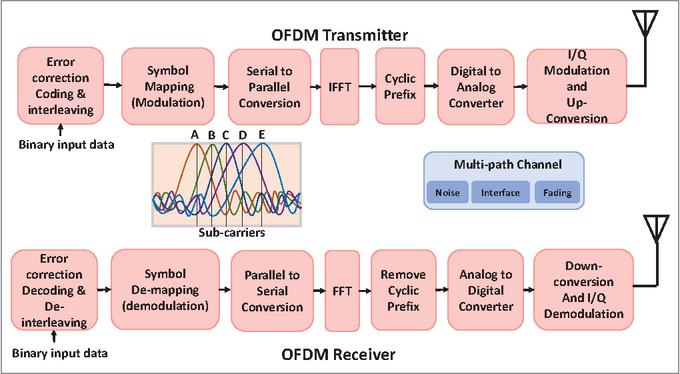
Figure 1 Basic OFDM Transceiver
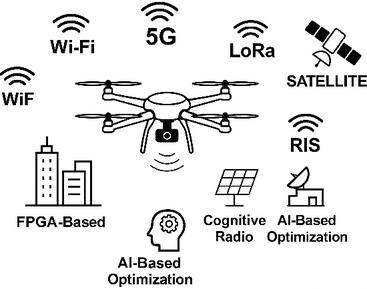
Figure 2 Illustration of a multi-standard OFDM UAV dynamically switching between 5G, Wi-Fi, IoT, and THz communication in different environments.
Table 1
| Comparison of wireless communication standards | |||||
| Standard | Frequency Band | Max Data Rate | Range | Primary Applications | References |
| Wi-Fi 6 (IEEE 802.11ax) | 2.4 GHz, 5 GHz | Up to 9.6 Gbps | Upto 35 m (indoor) | High-speed internet, video streaming, online gaming | [4, 9, 10] |
| Wi-Fi 7 (IEEE 802.11be) | 2.4 GHz, 5 GHz, 6 GHz | Upto 46 Gbps | Similar to Wi-Fi 6 | UHD streaming, virtual and augmented reality | [10] |
| Bluetooth (IEEE 802.15.1) | 2.4 GHz | Upto 3 Mbps | Upto 100 m | Wireless peripherals, audio devices, short-range data exchange | [7] |
| Zigbee (IEEE 802.15.4) | 2.4 GHz, 900 MHz, 868 MHz | 20–250 Kbps | 10–100 m | Home automation, industrial control, sensor networks | [2, 3, 6] |
| Cellular (5G) | Sub-6 GHz, mmWave (24–100 GHz) | Upto 10 Gbps | 500 m (mmWave), several km (Sub-6) | Mobile broadband, IoT, autonomous vehicles | [1, 5, 6, 13, 16] |
| WiMAX (IEEE 802.16) | 2.3 GHz, 2.5 GHz, 3.5 GHz | Upto 70 Mbps | Upto 50 km | Broadband wireless access, last-mile connectivity | [4, 9] |
In an OFDM transmitter, data bits are mapped onto symbols using modulation schemes such as QPSK, 16-QAM, or 64-QAM. The symbols are then transformed to the time domain using an Inverse Fast Fourier Transform (IFFT). To mitigate inter-symbol interference (ISI) caused by multipath propagation, a cyclic prefix (CP) is added to each OFDM symbol. At the receiver side, the reverse process is performed using a Fast Fourier Transform (FFT) to recover the transmitted data. Mathematically, the time-domain OFDM signal is expressed as:
| (1) |
where represents the data symbol on subcarrier , and is the number of subcarriers. To mitigate inter-symbol interference, a cyclic prefix of length is appended:
| (2) |
The transmitted OFDM signal becomes:
| (3) |
The UAV wireless communication channel is modeled as a discrete-time multipath fading channel:
| (4) |
The received signal is the convolution of the transmitted signal with the channel impulse response, plus additive white Gaussian noise:
| (5) |
At the receiver, after removing the cyclic prefix and applying FFT, the received subcarrier value is:
| (6) |
The symbol can be recovered via equalization:
| (7) |
3.2 Performance Metrics and Adaptation
OFDM supports adaptive modulation. The bit error rate (BER) for an M-QAM signal in an AWGN channel is approximated by:
| (8) |
with the Q-function as:
| (9) |
Spectral efficiency in bits/sec/Hz is given by:
| (10) |
where is the coding rate. To optimize link performance, the system can switch modulation orders based on SNR:
| (11) |
In reconfigurable systems, the delay for switching between standards is modeled as:
| (12) |
OFDM offers high spectral efficiency, robustness to frequency-selective fading, and ease of implementation using FFT algorithms [5, 7]. However, challenges such as high Peak-to-Average Power Ratio (PAPR) and sensitivity to timing and frequency errors remain [17]. Given these strengths, OFDM is well-suited for UAV communication systems that must operate reliably in dynamic and multipath-prone environments [1, 6, 8]. Wireless communication standards based on OFDM and other technologies are designed for different applications. UAVs benefit from multi-standard support, allowing them to switch between networks based on range, data rate, and environment. Table 1 summarizes key wireless communication standards used in UAV applications, covering use cases from high-speed video streaming and data exchange to low-power sensor transmission and long-distance broadband connectivity [1, 2, 9, 10, 16].
Table 2
| UAV communication standards and associated technical advancements | |||
| Wireless Standard/ | Key Technical Enhancements/ | ||
| Technology | UAV Use Cases | Research Focus | References |
| Wi-Fi(IEEE 802.11), WLAN | Short-range communication, live video, surveillance, multi-standard reception | SDR, FPGA-based partial reconfiguration, multi-stream synchronization, enhanced synchronization | [4, 9, 10] |
| LTE/5G/Wi-Fi | High-speed video, control links, urban monitoring, signal processing | OFDM, QAM schemes (16-QAM, 64-QAM), MIMO, Massive MIMO, full-duplex, ML integration, PLS | [1, 5, 6, 10, 13, 16] |
| NB-IoT/ LoRa | Low-power telemetry, rural/remote sensing | Adaptive modulation, long-range compatibility, low-power design | [2, 10, 14] |
| WiMAX/WRAN (IEEE 802.16 / 802.22) | Broadband access, rural internet backhaul | SDR-enabled reconfigurable front-end, partial reconfiguration for RAT switching | [4, 9] |
| mmWave (30–300 GHz) | Ultra-high-speed backhaul, dense urban UAV communication | Beamforming, MIMO, Doppler-division multiplexing, RIS integration, jamming mitigation | [7, 8, 13, 16] |
| Terahertz (THz) | Next-gen high-throughput UAV links | Ultra-broadband, PLS, THz-aware RF/antenna design, RIS-based optimization | [16, 18] |
| IM/DD OFDM,OFDM Variants(eU-OFDM,LACO, AVO,ACO, ALACO),OTFS | UAV-based swarm comms, high-mobility links, indoor coverage, delay-Doppler resilience | Zero-padding, DFT-spread OFDM, robust to fading, PAPR reduction, iterative decoding, cluster optimization | [5, 12, 17, 19, 20, 21] |
| FMCW Radar, MIMO Radar, Radar-Assisted Comms | Imaging, mapping, object detection, W-band environmental sensing | Beat frequency division, joint radar-comm, MIMO SAR, real-time W-band processing | [19, 18, 22] |
| Cognitive Radio (CR), SDR-Based Platforms | Dynamic spectrum access, emergency comms, CR-based UAV flight | AI-based spectrum sensing, adaptive transceivers, energy-efficient SDR, interference mitigation | [2, 6, 15] |
| Reconfigurable Intelligent Surfaces (RIS) | Smart reflection, enhanced coverage, cooperative UAV relays | Passive beamforming, MIMO/OFDM coordination, RIS-UAV trajectory control | [7, 8, 16, 18] |
| AI/ML-Driven Techniques | Real-time adaptive comms, energy efficiency | DL-based beamforming, path optimization, spectrum prediction, security enhancement | [2, 6, 10, 15] |
| Fault-Tolerant/Secure UAV Systems (Cross-Layer Models) | Safety-critical UAV missions, reliable multi-UAV networks | Physical layer security (PLS), encryption, fault-tolerant computing, intrusion prevention, CLR modeling | [1, 3, 11, 15, 16] |
3.3 Fundamentals of OFDM in UAV Communication
In the context of UAV communication, OFDM offers several advantages. It enhances performance in both urban and rural environments by reducing inter-symbol interference and enabling more efficient use of the available spectrum. Key benefits for UAV applications include robust handling of multipath propagation, high spectral efficiency, support for adaptive modulation and coding, and compatibility with a range of wireless standards such as Wi-Fi, LTE, and 5G. Despite these strengths, implementing OFDM in UAV systems presents several challenges. High Doppler shifts caused by UAV mobility can affect synchronization and signal quality. Additionally, power and hardware constraints in lightweight UAV platforms limit the complexity and processing capabilities of communication systems. Furthermore, integration with cognitive and adaptive networking technologies is essential to fully leverage OFDM’s flexibility in dynamic environments.
3.4 Multi-Standard Reconfigurable OFDM Transceivers
A multi-standard reconfigurable OFDM transceiver enables UAVs to operate dynamically across wireless networks. These transceivers employ techniques such as FPGA-based partial reconfiguration, software-defined radio (SDR), and cognitive radio technology. FPGA-Based Reconfiguration: FPGA-based transceivers allow UAVs to switch between standards like Wi-Fi, WiMAX, and WRAN with minimal reconfiguration delay, enhancing adaptability [4, 9]. Cognitive Radio for UAVs: Cognitive radios enable UAVs to detect and utilize available spectrum efficiently, improving spectral efficiency and reducing interference [2]. UAVs are used in diverse application environments, such as urban surveillance, rural connectivity, emergency rescue, and military operations. Each environment may rely on a different wireless standard, making it necessary for UAVs to support multiple standards. For instance, UAVs may need to switch between 5G for high-bandwidth video streaming, Wi-Fi for short-range communication, and LoRa or NB-IoT for low-power telemetry. A reconfigurable OFDM transceiver allows this seamless interoperability, enhances mission flexibility, and ensures reliable connectivity under varying network conditions [1, 9, 13].
3.5 Advanced Techniques for UAV OFDM Communication
To further enhance the performance of OFDM-based UAV communication systems, several advanced technologies have been explored:
Reconfigurable Intelligent Surfaces (RIS): RIS technology improves UAV connectivity by intelligently reflecting and steering signals to enhance coverage, manage interference, and reduce energy consumption—particularly in complex or obstructed environments [7].
Terahertz (THz) Communications: Operating at THz frequencies enables ultra-high-speed data transmission, offering significant potential for UAV communication in future-generation networks. This is particularly relevant for applications requiring massive data rates, such as real-time 3D mapping or ultra-HD video streaming[16].
Machine Learning for Adaptive Transceivers: AI-driven techniques, including machine learning algorithms, are increasingly being integrated into UAV communication systems. These approaches enable adaptive transceivers to optimize performance by predicting channel conditions and dynamically adjusting transmission parameters such as power, modulation, and coding rates in real time [10].
4 Multi-Standard OFDM-UAV Deployment for Various Communication Applications
Recent research from 2015 to 2025 highlights a significant evolution in wireless communication technologies, particularly in UAV-assisted networks (Table 2). Initial efforts [4, 9] focused on enabling multi-standard support through Software Defined Radios (SDRs), optimizing digital front-ends, and improving synchronization for multistream and concurrent receptions. These early contributions laid the foundation for flexible and adaptive architectures for next-generation mobile communications. Progressively, the adoption of various modulation schemes such as OFDM, QAM (including HQAM, RQAM, 16-QAM, 32-XQAM), PSK, and more recently, Orthogonal Time-Frequency Space (OTFS) modulation [1, 5, 10, 12, 17, 19, 20, 21] has enabled improved spectral efficiency, resilience to channel impairments, and higher data rates. These schemes have been enhanced through the integration of advanced techniques like DFT-spread OFDM, zero-padding, and efficient FFT/IFFT implementations [16, 20] allowing better performance in high-mobility or fast time-varying environments, such as UAV communications. Technologies such as MIMO, Massive MIMO, NOMA, mmWave, and full-duplex communication have become central to improving system throughput, coverage, and physical layer security in UAV-supported networks [1, 6, 7, 8, 13, 14, 16]. Researchers have explored their deployment in diverse environments, integrating features like joint communication and radar sensing, RIS-based beamforming, and Doppler-division multiplexing for enhanced link reliability and reduced latency [7, 16, 18]. Simultaneously, radar-based approaches, especially Frequency-Modulated Continuous Wave (FMCW) and MIMO radar, have been extensively explored for imaging, object detection, and deformation monitoring across W-band frequencies [18, 19, 22]. These techniques support real-time processing and have shown promising results on stationary and moving UAV platforms. In recent years, artificial intelligence, particularly machine learning (ML) and deep learning (DL), has been increasingly used to optimize signal processing and decision-making tasks. Applications include signal detection, proactive spectrum management, channel modeling, and UAV path optimization [2, 6, 7, 10, 15]. These advancements contribute to energy-efficient cognitive radio operations and improve the adaptability of UAVs to dynamic environments. Security and reliability have also received notable attention. Several studies [1, 3, 11, 15, 16] focus on improving physical layer security (PLS), developing encryption techniques resilient to real-time attacks, and creating fault-tolerant and self-adaptive UAV systems for safety-critical applications. Furthermore, research on cross-layer reliability models and holistic fault monitoring frameworks ensures system robustness across multiple UAV subsystems. Finally, recent efforts incorporate Reconfigurable Intelligent Surfaces (RIS), cooperative multi-UAV deployments, and joint radar-communication architectures to improve connectivity, reduce interference, and extend network coverage [8, 16]. These developments pave the way for efficient UAV-based communication platforms in 6G and beyond, emphasizing security, real-time adaptation, and low-complexity implementation.
5 Future Research Directions
Future research in UAV communication is expected to focus on several promising areas are
6G and Beyond: The integration of UAVs into 6G networks is anticipated to support ultra-reliable low-latency communication (URLLC) and massive machine-type communication (mMTC). These capabilities will enable advanced real-time applications such as autonomous navigation, remote healthcare, and immersive experiences [1, 13, 16].
Security and Privacy Enhancements: As UAVs become increasingly used in both civilian and defense sectors, secure communication protocols are essential to address potential threats such as cyberattacks, data breaches, and spoofing [3, 6, 15].
Energy-Efficient Communication: Power efficiency is crucial for UAV missions that require extended flight durations. Ongoing research aims to optimize transceiver hardware, develop energy-aware routing strategies, and utilize AI-driven power management to prolong operational life [10, 15].
Interoperability with IoT Devices: With the rapid expansion of smart cities and industrial IoT ecosystems, it is vital to enhance UAV communication frameworks for seamless integration with heterogeneous IoT devices. This will support applications such as large-scale environmental monitoring, infrastructure inspection, and next-generation logistics operations [1, 2, 18].
6 Conclusion
The emergence of reconfigurable OFDM transceivers marks a pivotal advancement in UAV communication, enabling the flexibility required for seamless multi-standard operations. Technologies such as FPGA-based reconfiguration, cognitive radio, Reconfigurable Intelligent Surfaces (RIS), and terahertz (THz) communication are driving the evolution of UAV networks toward high adaptability, efficiency, and scalability. These innovations improve connectivity and spectral utilization and ensure robust performance in diverse operational scenarios. Future research should continue to address critical challenges such as energy-efficient communication, enhanced physical layer security, and full integration with 6G architectures to fully harness the potential of UAV-assisted wireless communication systems.
References
[1] J. J. Sadique, S. E. Ullah, M. R. Islam, R. Raad, A. Z. Kouzani, and M. P. Mahmud, “Transceiver design for full-duplex uav based zero-padded ofdm system with physical layer security,” IEEE Access, vol. 9, pp. 59 432–59 445, 2021.
[2] G. M. Dias Santana, R. S. d. Cristo, and K. R. Lucas Jaquie Castelo Branco, “Integrating cognitive radio with unmanned aerial vehicles: An overview,” Sensors, vol. 21, no. 3, p. 830, 2021.
[3] F. Ahmed and M. Jenihhin, “A survey on uav computing platforms: A hardware reliability perspective,” Sensors, vol. 22, no. 16, p. 6286, 2022.
[4] T. H. Pham, S. A. Fahmy, and I. V. McLoughlin, “An end-to-end multi-standard ofdm transceiver architecture using fpga partial reconfiguration,” IEEE Access, vol. 5, pp. 21 002–21 015, 2017.
[5] P. K. Singya, N. Kumar, V. Bhatia, and F. A. Khan, “Performance analysis of ofdm based 3-hop af relaying network over mixed rician/rayleigh fading channels,” AEU-International Journal of Electronics and Communications, vol. 93, pp. 337–347, 2018.
[6] J. J. Sadique, S. R. Sabuj, S. E. Ullah, S. K. Joarder, and M. Hamamura, “Uav-aided transceiver design for secure downlink ow-dfts-ofdm system: A multi-user mmwave application,” IEEE Access, vol. 10, pp. 34 577–34 590, 2022.
[7] M. Yuan, H. Wang, H. Yin, and D. He, “Alternating optimization based hybrid transceiver designs for wideband millimeter-wave massive multiuser mimo-ofdm systems,” IEEE Transactions on Wireless Communications, vol. 22, no. 12, pp. 9201–9217, 2023.
[8] H. Noh, H. Lee, and H. J. Yang, “Ici-robust transceiver design for integration of mimo-ofdm radar and mu-mimo communication,” IEEE Transactions on Vehicular Technology, vol. 72, no. 1, pp. 821–838, 2022.
[9] S. Díaz, Z. Zhang, T. Hentschel, and G. Fettweis, “A new digital front-end for flexible reception in software defined radio,” Microprocessors and Microsystems, vol. 39, no. 8, pp. 1262–1272, 2015.
[10] D. Allan, E. Atimati, K. W. Barlee, L. J. Brown, J. Craig, G. Fitzpatrick, J. Goldsmith, A. Maclellan, L. D. McLaughlin, B. McTaggart, et al., Software Defined Radio with Zynq Ultrascale+ RFSoC. Glasgow, UK: Strathclyde Academic Media, 2023, vol. 1st.
[11] W. Abdallah, “A physical layer security scheme for 6g wireless networks using post-quantum cryptography,” Computer Communications, vol. 218, pp. 176–187, 2024.
[12] U. Iqbal, Y. Lee, S. Cho, I.-H. Lee, and H. Jung, “Cooperative transmission of uav swarm using orthogonal time–frequency space modulation,” ICT Express, vol. 10, no. 6, pp. 1240–1246, 2024.
[13] G. K. Pandey, D. S. Gurjar, H. H. Nguyen, and S. Yadav, “Security threats and mitigation techniques in uav communications: A comprehensive survey,” IEEE Access, vol. 10, pp. 112 858–112 897, 2022.
[14] M. Omor Faruk, J. Jafor Sadique, K. Cumanan, and S. Enayet Ullah, “Orthogonal variable spreading factor encoded unmanned aerial vehicle-assisted nonorthogonal multiple access system with hybrid physical layer security,” ETRI Journal, vol. 45, no. 2, pp. 213–225, 2023.
[15] E. E. Elsayed, “Investigations on ofdm uav-based free-space optical transmission system with scintillation mitigation for optical wireless communication-to-ground links in atmospheric turbulence,” Optical and Quantum Electronics, vol. 56, no. 5, p. 837, 2024.
[16] M. N. Hossain, K. S. Nisar, T. Shimamura, M. R. Islam, S. T. Kamal, and S. E. Ullah, “Transceiver design of a secure multiuser fdss-based dft-spread ofdm system for ris-and uav-assisted thz communications,” IEEE Open Journal of the Communications Society, 2025.
[17] S. K. Chronopoulos, “Flexible and reconfigurable ofdm implementation in dsp platform for various purposes and applications,” Sensors, vol. 24, no. 9, p. 2732, 2024.
[18] G. Xu, Y. Chen, A. Ji, B. Zhang, C. Yu, and W. Hong, “3-d high-resolution imaging and array calibration of ground-based millimeter-wave mimo radar,” IEEE Transactions on Microwave Theory and Techniques, vol. 72, no. 8, pp. 4919–4931, 2024.
[19] S. Y. Jeon, M. H. Ka, S. Shin, M. Kim, S. Kim, S. Kim, J. Kim, A. Dewantari, J. Kim, and H. Chung, “W-band mimo fmcw radar system with simultaneous transmission of orthogonal waveforms for high-resolution imaging,” IEEE Transactions on Microwave Theory and Techniques, vol. 66, no. 11, pp. 5051–5064, 2018.
[20] R. Bai and S. Hranilovic, “Absolute value layered aco-ofdm for intensity-modulated optical wireless channels,” IEEE Transactions on Communications, vol. 68, no. 11, pp. 7098–7110, 2020.
[21] Y. Wu, R. Mei, and J. Xu, “Non pilot data-aided carrier and sampling frequency offsets estimation in fast time-varying channel,” Big Data Research, vol. 36, p. 100461, 2024.
[22] S. Kim, J. Kim, C. Chung, and M.-H. Ka, “Derivation and validation of three-dimensional microwave imaging using a w-band mimo radar,” IEEE Transactions on Geoscience and Remote Sensing, vol. 60, pp. 1–16, 2022.
Biographies

V. C. Madhavi is currently pursuing her Ph.D. in the Department of Electrical and Electronics Engineering at BITS Pilani, Hyderabad Campus, with a research focus on wireless communication systems, FPGA-based implementation, and software-defined radio (SDR). She received her M.Tech. degree in VLSI and Embedded Systems and her B.Tech. degree in Electronics and Communication Engineering.

Subhendu Kumar Sahoo is a Professor in the Department of EEE at BITS Pilani, Hyderabad Campus. He received his B.E. in Electronics and Telecommunication Engineering from Utkal University, M.E. in Electronic Systems and Communication from REC (now NIT), Rourkela and earned his Ph.D. in VLSI Architecture from BITS-Pilani. His research interests include high-performance arithmetic circuits, VLSI circuits and architectures for DSP applications and low-power circuit design, currently focusing on the development of hardware accelerators and power-efficient design methodologies for next-generation computing platforms. He has published more than 70 peer-reviewed research papers, supervised nine Ph.D. scholars and also executed several funded research projects.