SDN-Enabled Energy-Aware Routing and Distribution for Circular Sustainable Industrial Ecosystems: A Dynamic Optimization Approach
Shivaleela Arlimatti1, 4,*, Rajesh Gade1, 5, Peter Lindgren2 and Suresh D. Mane3
1Department of Computer Science and Engineering, Warana University, Warananagar, Kolhapur, Maharashtra, 416113 India
2Copenhagen Business School, Copenhagen, Denmark
3Dr. D. Y. Patil Pratisthan’s College of Engineering, Kolhapur, Maharashtra, 416001 India
4Director, Sathodi Technologies Private Limited, Belgaum, Karnataka, 590006 India
5Director, Crystal Clear Imports and Exports, Kolhapur, Maharashtra, 416003 India
E-mail: sarlimatti@gmail.com; rajeshdgade@gmail.com; lindgren.peter@ctifglobalcapsule.org; mane.suresh@gmail.com
*Corresponding Author
Manuscript received 06 April 2025, accepted 14 July 2025, and ready for publication 15 August 2025.
© 2025 River Publishers
Abstract
The transition to circular sustainable industrial ecosystems necessitates innovative energy management solutions that balance environmental responsibility, efficiency, and social adaptability. This research introduces a Software-Defined Networks (SDN) enabled framework that integrates energy-aware optimization techniques to achieve real-time, dynamic energy management. The proposed system addresses key challenges in circular sustainable business models (CSBMs), such as optimizing energy distribution, minimizing waste, and integrating renewable energy sources, thereby supporting the transition to a circular economy. Industrial ecosystems often suffer from inefficient energy management, leading to high operational costs, increased carbon emissions, and poor resource utilization. To overcome these challenges, this research proposes an intelligent and dynamic energy management framework that leverages SDN’s centralized control and energy-aware routing algorithms to optimize energy flow in real time. This ensures efficient energy utilization, reducing both waste and costs while enhancing sustainability. The framework incorporates an energy-aware routing algorithm that prioritizes energy-efficient paths based on power consumption, latency, and carbon footprint. It integrates an SDN controller with Industrial Internet of Things (IIoT) sensors, which monitor energy consumption, environmental conditions, and renewable energy availability. This real-time data enables the system to dynamically adjust energy distribution, ensuring that energy supply meets demand efficiently. A key contribution of this research is the integration of renewable energy sources (e.g., solar panels) and energy storage systems (e.g., batteries) into industrial networks. This enhances sustainability by reducing dependence on non-renewable energy and lowering the carbon footprint. The framework is designed to be scalable and flexible, accommodating new energy sources, storage units, and production demands as industrial ecosystems expand. This research contributes to circular sustainable business models by enabling smarter, greener, and more resilient industrial energy management, aligning with Triple Bottom Line (TBL) principles to promote economic, environmental, and social sustainability.
Keywords: Circular sustainable business models (CSBMs), renewable energy, software defined networks (SDN).
1 Introduction
The increasing demand for sustainable industrial practices has driven a paradigm shift toward circular industrial ecosystems, where energy efficiency and resource optimization are critical [1]. Traditional industrial energy management systems often exhibit inefficiencies due to rigid architectures, limited dynamic energy distribution capabilities, and poor integration with renewable energy sources [2]. These shortcomings lead to higher operational costs, excessive energy waste, and increased carbon emissions, impeding progress toward a circular economy [3]. The push for sustainability and digital transformation has accelerated the adoption of advanced technologies enabling real-time, intelligent energy management [4]. By leveraging SDN and the IIoT, industries can improve energy efficiency, optimize distribution, and seamlessly integrate renewables [5].
SDN is a transformative technology that offers centralized control, programmability, and dynamic resource allocation, making it ideal for industrial energy optimization [6]. Unlike conventional energy networks with static configurations, SDN enables adaptive routing based on real-time demand, consumption patterns, and environmental factors [7]. When combined with energy-aware routing algorithms, SDN minimizes power losses and enhances sustainability in industrial ecosystems. Similarly, IIoT provides critical real-time data on energy consumption, production, and renewable generation, enabling smarter decision-making [5]. The integration of SDN and IIoT facilitates an intelligent energy management system that continuously optimizes energy flows, reducing costs and environmental impact.
Despite SDN’s potential, most research focuses on network optimization rather than holistic energy management in industrial settings. Existing approaches often lack adaptability to fluctuating energy demands and struggle with renewable integration [3]. Additionally, challenges such as computational complexity, data accuracy, and cybersecurity risks remain understudied. This research addresses these gaps by developing a dynamic SDN-enabled optimization framework for real-time energy distribution. By overcoming these limitations, the proposed system enhances efficiency, reduces carbon emissions, and supports circular economy principles through cross-sectoral business models (CSBMs) [3].
The primary objective of this study is to design a scalable, SDN-driven energy management system that optimizes industrial energy distribution. The framework incorporates energy-aware routing, integrates solar and battery storage systems, and dynamically adjusts flows using IIoT data. Additionally, the research investigates computational overhead and security risks while proposing mitigation strategies to improve system reliability and scalability.
2 Related Work
Circular Sustainable Industrial Ecosystems (CSIEs) are emerging as a pivotal framework in advancing sustainable industrial practices by promoting resource efficiency and waste minimization. This approach emphasizes the transformation of traditional linear production models into circular systems where waste is repurposed as input for other processes, thereby fostering environmental sustainability and economic resilience. Recent studies have highlighted the integration of circular economy principles within manufacturing sectors, identifying significant barriers such as economic, technological, and regulatory challenges, while also showcasing innovative strategies and business models that successfully apply circular principles [8].
The development and implementation of multi-business models within these symbiotic networks are considered critical for the successful realization of CSIEs. The concept of Green Multi Business Models has been extensively explored in paper [9], with a focus placed on the measurement and innovation of green business practices. The importance of designing business models that create, capture, deliver, receive, and consume value in alignment with sustainability goals is emphasized in his research. The complexity of balancing monetary and non-monetary value within business models, particularly in symbiotic networks involving multiple stakeholders, is highlighted by the authors. This balance is regarded as essential to ensure that green business models are genuinely sustainable rather than merely superficial adaptations [9].
In the context of industrial symbiosis, the efficient exchange of resources, energy, and information is facilitated through the collaboration between different enterprises. The significance of understanding the coherence between individual business models and the larger ecosystem in which they operate is underscored in one of the author’s works on business model ecosystems. This perspective is regarded as vital for the fostering of innovation and resilience within industrial symbiotic networks, as it allows for the strategic alignment of diverse business models towards common sustainability objectives [10, 11, 12].
The implementation of CSIEs necessitates robust and adaptable network infrastructures capable of managing complex and dynamic industrial processes. The integration of advanced technologies, such as SDN, into these ecosystems can further enhance their efficiency and adaptability. SDN offers centralized control and programmability of network resources, enabling dynamic optimization of data flows and energy consumption. This technological synergy supports the real-time monitoring and adaptive management of complex industrial processes, thereby reinforcing the sustainability and operational efficiency of CSIEs. Studies have demonstrated that SDN-based energy-aware routing protocols can optimize power consumption in Wireless Sensor Networks (WSNs) within the IIoT framework, supporting Industry 4.0 initiatives [13].
Further research has explored the application of SDN in multi-hop wireless sensor networks, proposing energy-aware routing algorithms and control overhead reduction techniques to prolong network lifetime. These approaches leverage SDN’s centralized control to optimize energy consumption, which is critical for the sustainability of IIoT services [14].
The convergence of SDN technology with CSIEs offers a promising avenue for achieving dynamic optimization in industrial processes. By enabling real-time monitoring and adaptive control of network resources, SDN facilitates the seamless integration of various industrial components, promoting sustainability and operational efficiency. This dynamic optimization approach addresses the energy demands of industrial networks and aligns with the overarching goals of circular economy principles, fostering resilient and sustainable industrial ecosystems [15].
3 System Model
The proposed system model integrates SDN with an Energy-Aware Algorithm to optimize energy distribution in circular sustainable industrial ecosystems. The model leverages SDN’s centralized control capabilities to dynamically manage energy flows while ensuring alignment with CSBMs. By incorporating real-time data collection, renewable energy prioritization, and energy-aware optimization techniques, this system enhances energy efficiency, reduces waste, and contributes to environmental and economic sustainability. The Energy-Aware Algorithm, a core component of the system, is designed to select the most energy-efficient paths within an industrial network by considering factors such as power consumption, latency, and the availability of renewable energy sources.
In conventional industrial networks, shortest path algorithms are commonly used to determine the shortest path based on metrics like distance or latency. However, this approach does not account for energy consumption or sustainability. The modified Energy-Aware Algorithm redefines the path selection process by incorporating energy-related metrics, ensuring that energy is distributed through the most sustainable and circular pathways. The algorithm assigns weights to network edges based on power usage, energy efficiency, carbon footprint, and renewable energy availability. This weighted graph representation allows the system to prioritize routes that minimize energy waste while maximizing the utilization of sustainable energy sources.
The industrial network is modeled as a graph (shown in Figure 1) where nodes represent industrial devices, renewable energy sources, and energy distribution points, while edges signify energy distribution and communication links. Each edge in the graph is assigned a weight based on its energy consumption and sustainability metrics. A priority queue mechanism ensures that the algorithm selects the most energy-efficient path first, improving network adaptability and scalability. The Energy-Aware Algorithm operates in a stepwise manner, beginning with the initialization of tentative energy costs for all nodes, followed by iterative path exploration based on energy-aware metrics. Nodes are marked as visited once analyzed, preventing redundant computations and enhancing efficiency. The algorithm then reconstructs the most sustainable path, ensuring optimal energy distribution in real time.
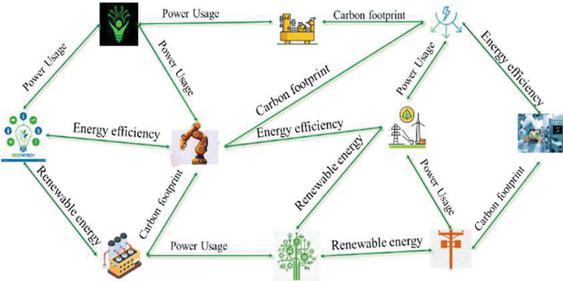
Figure 1
Modeled industrial network.
One of the key advantages of integrating SDN with energy-aware routing is the system’s real-time adaptability. The SDN controller continuously collects data from IIoT sensors deployed across the industrial ecosystem. These sensors monitor various parameters, including energy consumption, production rates, and environmental conditions. Based on this data, the SDN controller dynamically adjusts energy flows, ensuring that energy supply aligns with real-time demand while prioritizing sustainability. The system seamlessly integrates renewable energy sources, such as solar panels and battery storage systems, to reduce reliance on non-renewable energy and lower the overall carbon footprint of industrial operations.
The proposed system model offers several advantages, including enhanced energy efficiency, circularity, flexibility, and scalability. By prioritizing energy-efficient paths, it minimizes operational costs and ensures that energy is distributed in a sustainable manner. The circular economy principles embedded within the model promote resource efficiency and closed-loop energy management, reducing waste and optimizing renewable energy use. Furthermore, the model is designed to accommodate future industrial expansion, allowing for the seamless integration of additional production units, energy sources, and storage systems. The combination of SDN, energy-aware routing, and renewable energy integration provides an intelligent and adaptive solution for real-time dynamic energy management in circular industrial ecosystems, paving the way for smarter, greener, and more sustainable industrial practices.
4 Working of Proposed Framework
The proposed system formalizes the optimization of energy distribution using SDN and Energy-Aware Algorithm. The model aims to minimize energy waste, maximize renewable energy utilization, and ensure an efficient, sustainable energy flow in industrial ecosystems.
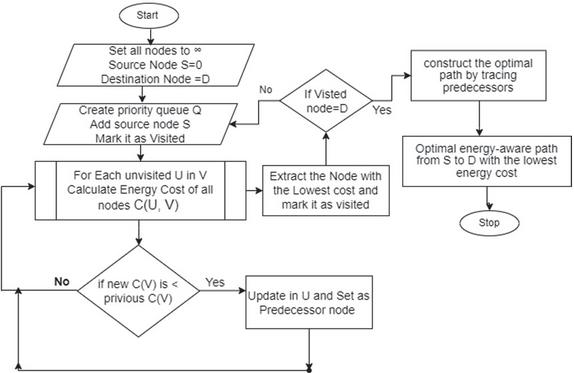
Figure 2
Flow chart of the proposed framework.
Algorithm 1:
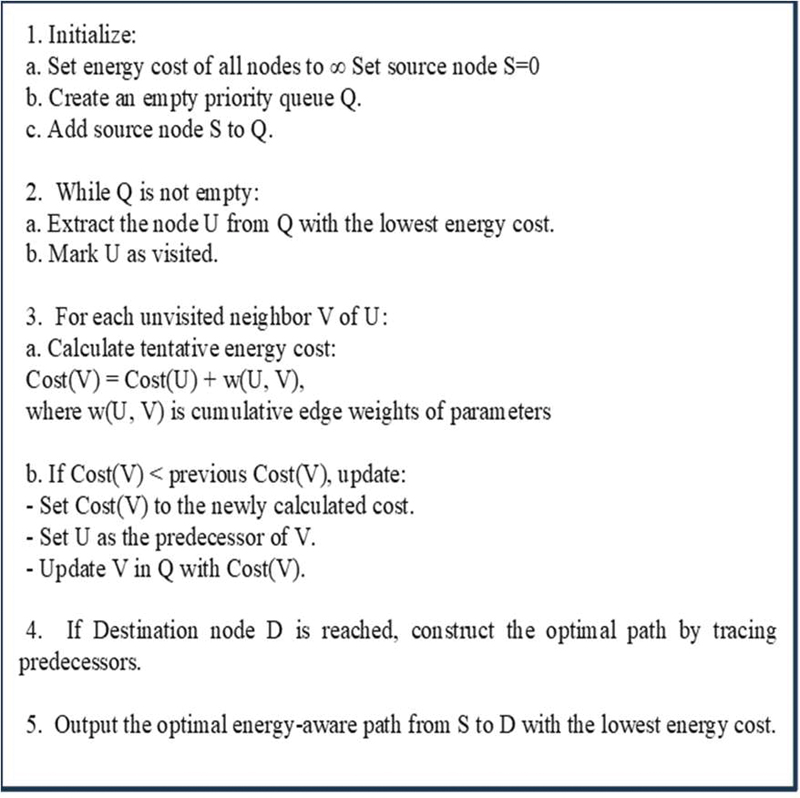
Energy aware routing algorithm.
The Algorithm shown below (Algorithm 1) in industrial network is represented as a weighted graph (as shown in Figure 2), where nodes correspond to industrial devices, renewable energy sources, and distribution points, while edges represent energy distribution links between these nodes. The edge weights are determined based on real-time energy consumption data, with lower weights assigned to paths that have lower energy costs and higher renewable energy contributions. The SDN controller continuously collects data from IIoT sensors deployed across the industrial ecosystem, enabling real-time adjustments to energy routing decisions based on dynamic demand and supply conditions.
The algorithm begins with an initialization step, where all nodes are assigned a tentative energy cost of infinity, except for the source node, which is set to zero. A priority queue is used to select the node with the lowest tentative energy cost, ensuring that the most energy-efficient paths are explored first. The algorithm iteratively examines neighboring nodes, updating their energy costs based on metrics such as energy efficiency, latency, and renewable energy utilization. If a more efficient path is found, the tentative cost is updated, and the process continues until all nodes are visited or the most energy-optimal path is identified. The final step involves reconstructing the optimal path from the destination back to the source, ensuring that energy is distributed through the most sustainable and cost-effective routes.
A key advantage of this algorithm is its real-time adaptability when integrated with SDN. The SDN controller dynamically adjusts energy flow paths based on fluctuating energy demand, renewable energy availability, and operational constraints. This scalability and flexibility make it particularly effective for smart factories and industrial ecosystems, where energy demands frequently change due to varying production loads and external conditions. And by prioritizing paths that maximize renewable energy use, the framework significantly reduces dependence on non-renewable energy sources, thereby lowering carbon emissions and operational costs.
The Energy-Aware Algorithm offers a scalable, intelligent, and sustainable solution for real-time energy optimization in industrial settings. By combining SDN-driven centralized control with circular sustainability principles, it ensures optimal energy efficiency, reduces waste, and supports the transition toward a circular economy. This approach paves the way for greener, more resilient industrial operations, shaping the future of sustainable energy management in industrial ecosystems.
5 Results and Discussion
The proposed SDN-enabled energy-aware routing framework demonstrates significant improvements in energy management for circular sustainable industrial ecosystems. By integrating SDN with an Energy-Aware Algorithm, the system dynamically optimizes energy distribution, ensuring efficient utilization of available energy resources while minimizing waste. This approach enables real-time decision-making based on factors such as power consumption, latency, energy efficiency, and renewable energy availability, making industrial energy networks more sustainable and resilient.
One of the key outcomes of this framework is the optimization of energy flow through intelligent routing. Unlike traditional energy management systems that operate on static configurations, this approach continuously adjusts energy paths based on real-time data collected from IIoT sensors. The integration of real-time monitoring and SDN control allows for dynamic adaptation to fluctuating energy demands, preventing inefficiencies caused by over- or under-utilization of resources. This adaptability is crucial in industrial environments, where energy consumption varies based on production loads, external conditions, and operational constraints.
Another major benefit of this approach is the prioritization of renewable energy sources in the energy routing process. By incorporating renewable energy availability into the path selection algorithm, the system ensures maximum utilization of solar, wind, and energy storage systems, thereby reducing reliance on non-renewable energy sources. This directly contributes to lower carbon emissions, supports environmental sustainability, and aligns with circular economy principles by promoting efficient resource utilization.
The proposed framework also enhances energy efficiency by selecting the most energy-optimal paths, reducing overall power consumption and operational costs. Traditional routing methods often prioritize shortest-distance paths, which may not necessarily be the most energy-efficient. In contrast, the Energy-Aware Algorithm evaluates multiple sustainability-related metrics, ensuring that the selected paths minimize energy losses and improve network-wide efficiency.
The proposed SDN-enabled energy-aware routing framework offers a scalable and sustainable solution for real-time energy management in circular industrial ecosystems. By integrating centralized control, real-time monitoring, and energy-aware optimization, the system significantly enhances energy efficiency, reduces waste, and promotes the use of renewable energy sources. This approach plays a critical role in advancing CSBMs, ensuring that industrial operations remain economically viable, environmentally responsible, and socially sustainable.
6 Conclusion
The proposed SDN-enabled energy-aware routing framework presents a dynamic and efficient solution for real-time energy management in circular sustainable industrial ecosystems by integrating SDN and an Energy-Aware Algorithm. This approach optimizes energy distribution by prioritizing power efficiency, renewable energy utilization, and sustainability, reducing waste and minimizing carbon emissions while ensuring adaptability to fluctuating energy demands. The integration of real-time monitoring through IIoT sensors and centralized SDN control enhances flexibility, making industrial energy networks more resilient and efficient. Although challenges such as computational complexity, data accuracy, and cybersecurity risks remain, addressing these aspects will further strengthen the framework’s scalability and reliability. This research contributes to advancing CSBMs by enabling smarter, greener, and more sustainable industrial energy management that aligns with the principles of the circular economy and the TBL approach.
References
[1] Lorincz, Josip, Antonio Capone, and Jinsong Wu. “Greener, energy-efficient and sustainable networks: State-of-the-art and new trends.” Sensors 19, no. 22 (2019): 4864.
[2] Mahapatra, Bandana, and Anand Nayyar. “Home energy management system (HEMS): Concept, architecture, infrastructure, challenges and energy management schemes.” Energy Systems 13, no. 3 (2022): 643–669.
[3] Okorie, Okechukwu, Jennifer Russell, Ruth Cherrington, Oliver Fisher, and Fiona Charnley. “Digital transformation and the circular economy: Creating a competitive advantage from the transition towards Net Zero Manufacturing.” Resources, Conservation and Recycling 189 (2023): 106756.
[4] El Zein, Musadag, and Girma Gebresenbet. “Digitalization in the renewable energy sector.” Energies 17, no. 9 (2024): 1985.
[5] Al-Rubaye, Saba, Ekhlas Kadhum, Qiang Ni, and Alagan Anpalagan. “Industrial internet of things driven by SDN platform for smart grid resiliency.” IEEE Internet of Things Journal 6, no. 1 (2017): 267–277.
[6] Chen, Junyan, Wei Xiao, Hongmei Zhang, Jiacheng Zuo, and Xinmei Li. “Dynamic routing optimization in software-defined networking based on a metaheuristic algorithm.” Journal of Cloud Computing 13, no. 1 (2024): 41.
[7] Li, Yan, Yanyuan Qin, Peng Zhang, and Amir Herzberg. “SDN-enabled cyber-physical security in networked microgrids.” IEEE Transactions on Sustainable Energy 10, no. 3 (2018): 1613–1622.
[8] Dennison, Milon Selvam, M. Bhuvanesh Kumar, and S. Kirubanidhi Jebabalan. “Realization of circular economy principles in manufacturing: obstacles, advancements, and routes to achieve a sustainable industry transformation.” Discover Sustainability 5, no. 1 (2024): 438.
[9] Lindgren, Peter, Niklas Stoyan Hornbæk Knoth, Sukanthan Sureshkumar, Mathilde Fogh Friedrich, and Rita Adomaityte. ““Green Multi Business Models” How to Measure Green Business Models and Green Business Model Innovation?.” Wireless Personal Communications 121 (2021): 1303–1323.
[10] Rasmussen, Ole Horn, and Peter Lindgren. “Two Black Boxes: Understanding the coherence between Business Models & Business Model Eco Systems-A Contribution toward a definition of the object for Business Model Innovation and the question of “Where to Look”.” Journal of Multi Business Model Innovation and Technology 3, no. 3 (2016): 67–132.
[11] Lindgren, Peter. “The Business Model Eco–System.” Journal of Multi Business Model Innovation and Technology 4, no. 2 (2016): 1–50.
[12] Lindgren, Peter. “The impact on Multi Business Model Innovation related to GDPR regulation.” (2020).
[13] Almuntasheri, Sumayah, and Mohammed JF Alenazi. “Software-defined network-based energy-aware routing method for wireless sensor networks in industry 4.0.” Applied Sciences 12, no. 19 (2022): 10073.
[14] Jurado-Lasso, F. Fernando, Ken Clarke, Andres Navarro Cadavid, and Ampalavanapillai Nirmalathas. “Energy-aware routing for software-defined multihop wireless sensor networks.” IEEE Sensors Journal 21, no. 8 (2021): 10174–10182.
[15] Naeem, F., Tariq, M., & Poor, H. V. (2020). SDN-enabled energy-efficient routing optimization framework for industrial Internet of Things. IEEE Transactions on Industrial Informatics, 17(8), 5660–5667.
Biographies

Shivaleela Arlimatti is accomplished individual in the field of Computer Science and Engineering. She is the director of Sathodi Technologies private limited. She completed her PhD at the University Utara Malaysia, Malaysia, and holds a Master of Technology degree from the University of Mysore, Mysore. Currently, she serves as a Professor and the Head of the Department at Tatyasaheb Kore Institute of Engineering & Technology, Warana University Warananagar, Kolhapur, Maharashtra, India. With a remarkable teaching career spanning 20 years, Shivaleela has made significant contributions to the academic community. Her expertise and dedication are evident in her extensive research work. She has published 25+ research papers in both national and international journals and conferences, showcasing her commitment to advancing knowledge in her field. She has contributed to the academic literature through book chapters. She has two patents and one copyright published on her name.
Arlimatti’s professional affiliations include being a life member of the Indian Society for Technical Education (ISTE) and the Indian chapter of the Internet Society (ISOC). She is also a member of the Malaysian chapter of ISOC, further highlighting her international connections and collaborations. Through her research, teaching, and active involvement in professional organizations, Shivaleela Arlimatti continues to make valuable contributions to the field of Computer Science and Engineering, inspiring and guiding future generations of students and researchers.

Rajesh Gade holds a Master of Engineering in Computer Science and Engineering and a Bachelor of Engineering in Information Technology. With extensive experience in the technology and business sectors, Rajesh has worked with leading companies such as Infosys, Wipro, and Juniper Networks. A practitioner of Multi-Business Model Innovation and the Business Model Canvas, he has been instrumental in helping organizations develop innovative business strategies. Rajesh served as the Chief Operating Officer (COO) for KITE – KIT’s Incubation for Technology Entrepreneurship, where he played a key role in fostering technological innovation and entrepreneurship. In addition to his work in technology and academia, Rajesh has hands-on experience in cashew manufacturing and jaggery trading and exports, further expanding his business expertise across diverse sectors. Rajesh was also a Task Manager for the European Union’s ERASMUS+ project CENTRAL, where he contributed to the development and management of the project across several countries, including Denmark, Thailand, Malaysia, and other parts of Europe. This international exposure allowed him to work on significant cross-border initiatives, fostering collaboration between academic and industry stakeholders globally. Currently, Rajesh serves as an Assistant Professor and Central Learning Management Head at Warana University, where he is focused on advancing education and learning management. He is also the Founder and Director of Crystal Clear Imports and Exports and Founder Director of INNOeVERSITY, focusing on global business development and innovation. Rajesh is passionate about mentoring aspiring entrepreneurs and professionals, helping them navigate the complexities of business development, international trade, and global collaborative projects.

Peter Lindgren is Vice President of CTIF Global Capsule (CGC) and is External Lecturer at Department of International Economics, Government and Business (EGB) Copenhagen Business School. Peter Lindgren held a full Professorship until 1 December 2023 in Multi business model and Technology innovation at Aarhus University, Denmark Dept. of Business Development and Technology (BTECH) and i. He was Director of CTIF Global Capsule/MBIT Research Centre at Aarhus University – BTech and member of Research Committee at Aarhus University – BSS. He has researched and worked with network based high-speed innovation since 2000. He has been head of Studies for Master in Engineering – BTECH at Aarhus University from 2014–2016 and member of the management group at Aarhus University BTECH 2014–2018. He has been researcher at Politecnico di Milano in Italy (2002/03), Stanford University, USA (2010/11), University Tor Vergata, Italy (2016/2017) and has from 2007–2011 been the founder and Centre Manager of International Centre for Innovation at Aalborg University (AAU), founder of the MBIT research group and lab, and is cofounder of CTIF Global Capsule www.ctifglobalcapsule.org. He has worked as researcher in many different multi business model and technology innovation projects and knowledge networks among others, E100 – http://www.entovation.com/kleadmap/, Stanford University project Peace Innovation Lab, The Nordic Women in business project, The Centre for TeleInFrastruktur (CTIF), FP7 project about “multi business model innovation in the clouds” – www.Neffics.eu, EU Kask project – www.Biogas2020.se, Central Project, www.Motor5G.eu, www.Greenbizz.eu, www.einst4ine.eu.
He is cofounder of six startup businesses amongst others – www.ctifglobalcapsule.org, www.mountmedia.dk, www.thebeebusiness.com, the www.thedigibusiness.com and www.vdmbee.com. He is author of several articles and books about business model innovation in networks and Global Business Models – https://vbn.aau.dk/da/publications/ict-a-key-enabler-in-innovating-new-global-business-models. He has an entrepreneurial and interdisciplinary approach to research. His research interests are multi business model and technology innovation in interdisciplinary networks, multi business model typologies, sensing-, persuasive- and virtual-business models. He has been serving as guest editor and reviewer for many highly respected journals and conferences.

Suresh D. Mane is a distinguished academic and engineering professional with a strong educational background, holding a Ph.D. in Industrial & Production Engineering from Kuvempu University (2015), an M.Tech. in Energy Systems Engineering from BVB College of Engineering (VTU, 2007), and a B.E. in Mechanical Engineering from Karnatak University (1991). His doctoral research focused on energy performance and environmental sustainability in Indian Railway workshops, resulting in ten peer-reviewed international publications. With over 32 years of experience – 20 in South Western Railways and 12+ in academia. Mane has held key leadership roles, including Principal at Dr. D Y Patil College of Engineering (2022–present) and Girijabai Sail Institute of Technology (2015–2022), where he drove institutional growth through NAAC/NBA accreditation, faculty development, and infrastructure modernization. His earlier roles include senior engineering positions in Railways, earning him 12 meritorious service awards.
Mane’s research spans energy conservation, biodiesel applications, thermal engineering, accreditation, Outcome-Based Education (OBE), and sustainable education. He has guided three Ph.D. candidates, published 57 Scopus/SCI-indexed papers, and contributed chapters to Springer publications. Notable projects include biofuel applications in engines and energy audits in railway workshops. A dynamic leader, he has spearheaded NAAC accreditation, established advanced research labs, organized 20+ conferences, and conducted 30+ faculty development programs. Recognized for his contributions, he holds an impressive API score of 777 under UGC’s PBAS Category III and serves as an editorial reviewer for leading journals.
A Fellow of the Institution of Engineers (India) and a Certified Energy Manager (BEE), Mane has received multiple accolades, including the Best Principal of the Year (2023) and the Education Excellence Award (2024). His blend of administrative expertise and research innovation continues to advance higher education and sustainable engineering practices.
Wireless World Research and Trends, Vol. 2, Issue 1, 15–20.
DOI. No. 10.13052/2794-7254.016
© 2025 River Publishers