Channel Modeling using Deep Neural Network with RIS-powered Wireless Communication Systems
Kumud S. Altmayer1,*, Ilya Burtakov2 and Hussain Al-Rizzo1
1Department of Systems Engineering, College of Engineering and Information Technology, University of Arkansas at Little Rock, USA
2Wireless Networks Lab, Institute for Information Transmission Problems, Russian Academy of Sciences, Moscow, Russia
E-mail: ksaltmayer@ualr.edu; burtakov@wireless.iitp.ru; hmalrizzo@ualr.edu
*Corresponding Author
Manuscript received 10 June 2025, accepted 03 December 2025, and ready for publication 31 December 2025.
© 2025 River Publishers
DOI. No. 10.13052/2794-7254.027
Abstract
This work deals with Reconfigurable Intelligent Surfaces or (also known as Intelligent Reflecting Surfaces) which provide an improvement of performance of wireless communications by utilizing software-controlled meta-surfaces for the reflected signals from the source to destination, especially when the direct path is weak and hence improving the antenna array.
The performance evaluation is done by one of the techniques that utilizes the very high rates and/or large meta-surfaces to outperform the classic method of decode and forward, both in terms of the total transmit power and the energy efficiency. The channel measurements used by classifying them as a function of the frequency band, and usage of deployment scenarios such as indoor/outdoor, and system configuration. So, the 5G and beyond which is 6G use several antennas including the algorithms to make use of signal processing. This improves the antenna array technology.
In the next steps, we work on machine learning-based performance prediction using a deep neural network (DNN) to evaluate the performance of the RIS-aided system in the low-frequency range. This would provide a greater influence of scatterers with a weaker signal attenuation allowing the neural network to pick up a larger number of features, e.g. accurately predicting the energy efficiency (EE), and outage probability (OP).
Keywords: LIS, RIS, 5G, 6G, millimter waves, FR2, Terahertz, MIMO, neural networks.
1 On Reconfigurable Intelligent Surfaces
Reconfigurable Intelligent Surface (RIS) technology is a promising way to improve the performance of wireless communication systems. The RIS is a two-dimensional surface that can be built using electromagnetic meta-materials. Such surfaces have a potential for the capacity improvement and coverage extension as a result of partial control of propagation environment, [4]. Also, “Large” refers to the size of the intelligent surface and the large number of passive elements it contains, while “reconfigurable” highlights its key feature of being programmable to manipulate signals in real-time. Thus, large intelligent surfaces (LIS) and reconfigurable intelligent surfaces (RIS) are two terms for the same technology, with “reconfigurable intelligent surfaces (RIS)” being the more common and modern term.
One should note that for a MIMO channel with no RIS, the throughput is determined by the channel matrix y=Hx. Each element determines signal gain , the phase shifts to the RIS elements, [1]. When one is working on beyond 5G, the advent of electromagnetic components that can shape how they interact with wireless signals enables partial control of the propagation.
2 Mathematical Theory of RIS and Machine Learning Implementation
An RIS is a thin surface composed of N elements, each being a small antenna that receives and passively re-radiates with a configurable time delay. For the narrowband signals, this delay corresponds to a phase shift. Assuming the phase shifts are properly adjusted, the scattered waves add constructively at the receiver. This principle resembles traditional beamforming; each element has a fixed radiation pattern, but the collection of phase shifts determines where constructive interference among the scattered waves occurs. RIS can be modified and is called LIS. In other words, LIS can both generate and reflect electromagnetic waves, while RIS is only used to reflect electromagnetic waves. For machine learning simulations, RIS has been replaced by LIS.
We consider the scattering process with User elements. The signal received is and may not be noise free at the multiple antennas together with multiple transmit antennas as follows
| (1) |
where . The noise is
It belongs to for the signal, and is the signal.
The matrix corresponds to the direct connection between and . R is the channel coefficient and the phase shifting is written as below representing the diagonal RIS reflection matrix:
We consider the diagonal matrix from equation (2), that describes the incident signal amplification and phase shift of the each UC. By turning the phase shifts of UCs, the RIS induces some phase between the reflected signals and make them interfere either between the reflected signals and make them interfere either constructively so that the desired signal strength increases at the receiver or destructively to mitigate the co-channel interference. The matrix corresponds to the direct connection between and . R is the channel coefficient and the phase shifting is written as below representing the diagonal RIS reflection matrix:
| (2) |
where each element determines the signal gain of . The represent corresponding phase shifts to the UCs. One should note that for a MIMO channel with no RIS, the throughput is determined by the channel matrix .
In its most simplest form, an RIS can be implemented as a dynamic reflectarray, whose elements are omnidirectional antennas with controllable termination that can be changed dynamically to backscatter and phase shift the incident waveform. A more elaborate implementation would be using a dynamically tunable metasurface, a 2D planar form of metamaterials that has been shown to possess great electromagnetic wave manipulation capabilities. Relying on the metasurface implementation, an RIS element can not only scatter and phase-shift the signal but can also act as an anomalous mirror with a controllable reflection angle and even polarization manipulation abilities.
Now we discuss the main formulas pertaining to the calculation of achievable rate and outage probability by using RIS and machie learning method. There are two approaches from the literature to tackle the problem of optimizing the RIS configuration with limited channel information. The first approach is to forgo channel estimation altogether; instead, the optimization of the RIS can be based on feedback from the receiver. This can be done using a predefined codebook of beam directions; however, the size of the codebook will be proportional to the number of elements.
3 Methods of Channel Modeling Together with Deep Neural Network and RIS
In order to model propagation channels, we are looking for path loss by using RIS-assisted wireless systems. The emitted signal from the transmitter arrives at the receiver as a superposition of multiple signals passing through the channel with RIS and clusters with a controlled feedback link, see Figure 1(a).
The main idea is to consider the statistical properties of scatterers and clusters in the environment. This represents an RIS-aided wireless communication system. We compare the results by mainly using the software QuadriGa with SIMRIS in the MATLAB environment. All these show, how one can model with no limit on the number of antenna elements and a transition between LOS and NLOS scenarios.
3.1 Main Items for Channel Modeling
• LOS and NLOS estimation with scenarios, e.g. UMi (urban microcell), RIS moving with respect to SNR capacity versus rate is used.
• For beyond 5G, the advent of electromagnetic components can shape interaction with wireless signals along with partial control of the channel propagation [1, 4].
• The frequency range is FR2, 28 GHz covering 5G and 6G and of a channel.
• A reconfigurable intelligent surface (RIS) is a two-dimensional surface of engineered material with properties not static.
• Input variables: Number of Users, Number of transmit Antennas and Receiving antennas
• Number of RIS elements. In general 30 or 40.
• The downlink bandwidth will be greater than 28-30 GHz, and channel bandwidth is Rayleigh fading
• The model is stationary, and is unsupervised, could be changed to supervised.
• The Optimizer is designed in Matlab with deep learning using the convolutional and deep neural network.
• Number of data symbols as input and the reflection matrix has
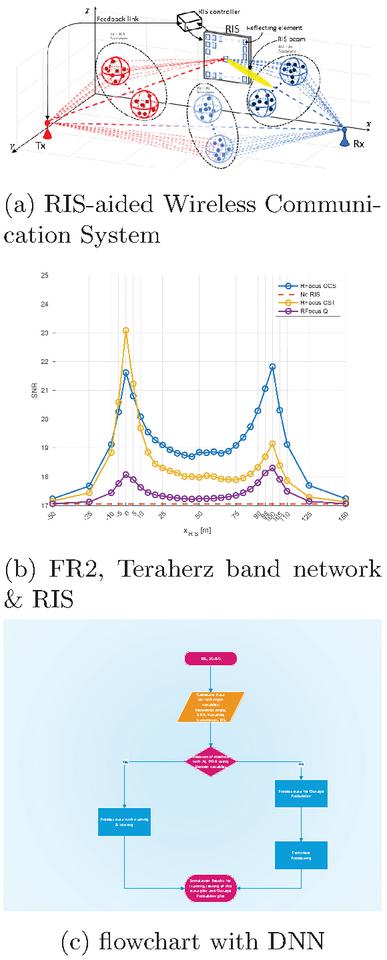
Figure 1 RIS-simulations.
Table 1
| Root mean square (RMSE) and DNN performance | |||||||
| Epoch | Iteration | Time Elapsed | Minibatch1 | Validation1 | Minibatch2 | Validation2 | Base Learning |
| 1 | 1 | 04 | 142.27 | 137.37 | 10120.57 | 9435.50 | 2.1e-6 |
| 4 | 50 | 53 | 55 | 57.43 | 1513.89 | 1655.40 | 2.1e-6 |
| 7 | 100 | 43 | 23.30 | 27.40 | 271.30 | 373.80 | 2.1e-6 |
In Figure 1(b), the RIS position are varied, and the SNR are measured for COS-UC, Q-UC and CST-UC. RIS is configured by using the ON-OFF algorithm. The powers used are , dBm, and , dBm, noise power. , the UCs, and operating frequency is 5.3 GHz. Figure 1(c) and Figure 2(b) provide an idea of the deep neural network implementation. For the validation of CST-UC behaviour, a comparison of free-space scenarios was done by using QRIS with CST-UC and full-wave simulation in CST. It’s done by modeling half-wave antenna in CST and then it’s imported into QRIS to make the transmitter and receiver behaviour same in both cases.
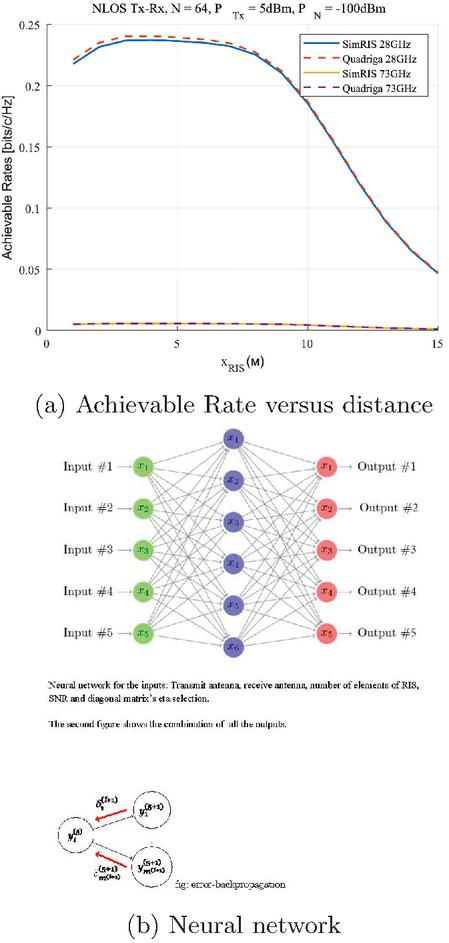
Figure 2 Rates and neural network.
The power is calculated as below:
| (3) |
where is the wavelength. is the transmitting power, , and are radiation patterns of and respectively. The and are the angle of departure and angle of arrival. For the validation, in Watts both in QRIS and CST. Please see the Figure 2(a).
3.2 Simulation with Machine Learning and RIS
To train the network we create different scenarios by using different number of RIS-elements and different number of transit and receive antennas with different number of users, [6]. The physical environment is modeled such that the directions are uniform randomly drawn from the interval . The coefficient in the diagonal matrix is chosen with permittivity approximately equal to zero. The details of simulations are shown in Table 1.
4 Conclusion & Future Work
Usage of DNNs provides superior estimation accuracy, especially in complex channel conditions used here with typical of millimeter-wave (mmWave) and terahertz (THz) frequencies. The table above shows that the RMSE (Root Mean Square Error) is improved with DNN. RIS approach is used for designing and analyzing RIS-assisted systems, optimizing performance, and understanding of the RIS affect on the overall wireless channel. With no RIS or LIS implies the modeling of the wireless environment which has no additional, programmable element, and uses the traditional channel models that consider only direct or reflected paths between transmitters and receivers, and without the complex phase-shifting and beamforming capabilities of the surface. In this work only one receiver is used and it implies only one user. This work can be extended for several users including obstacles.
Acknowlegement
The author Kumud Singh-Altmayer would like to thank Hitesh Poddar, senior graduate student, New York University for several discussions on millimeter waves.
References
[1] I. Burtakov, A. Kureev, A. Tyarin, E. Khorov, QRIS: QuadriGa-Based Simulation Platform for Reconfigurable Intelligent Surfaces, IEEE Open Access, vol. 4, 2023.
[2] S. Dorokhin, P. Lysov, V. Lyashev, A. Kunavin1, A. Aderkina1, RIS-Assisted MIMO Channel Modeling with Spatially Consistent Sparsified Properties, Wireless Personal Communications, Springer, 2024.
[3] Ö. Özdogan, E. Björson, Deep Learning-based Phase Reconfiguration for Intelligent Reflecting Surfaces, arXiv:2009.13988v1, 2009.
[4] E. Björnson, H. Wymeersch, B. Mattheienen, P. Popovski, L. Sanguinetti, and E. de Carvalho, Recofigurable Intelligent Surfaces: A Signal Processing Perspective With Wireless Appllications,arXiv:2102.00742v2, 2021.
[5] B. Ozpoyraz, A. T. Dogukan, Y. Gevez,U. Altun, and E. Basar, Reconfigurable Intelligent Surfaces for Future Wireless Networks: A Channel Modeling Perspective, IEEE Open Journal of the Communications Society, vol. 3, pp. 1749-1809, 2022.
[6] A. Elbir, A. Papazafeiropoulos, P. Kourtessis, and S. Chatzinotas, Deep Channel Learning For Large Intelligent Surfaces Aided mm-Wave Massive MIMO Systems, arXiv:2001.11085v3, 2020.
[7] R. Faqiri, C. S. Tardiff, G. C. Alexandropoulos, and P. Hougne, PhysFad: Physics Based End to End Channel Modeling of RIS Parametrized Environments with Adjustable Fading, arXiv:2202. 02673v1, 2022.
[8] H. Poddar, S. Ju, D. Shakya and T. S. Rappaport, A Tutorial on NYUSIM: Sub-Terahertz and Millimeter-Wave Channel Simulator for 5G, 6G and Beyond, IEEE Communications Surveys Tutorials, December 2023.
Biographies

Kumud S. Altmayer did her Ph.D. in Applied Math from Hungarian Academy of Sciences, Budapest, Hungary during 1987. Now, doing research work in the area of channel modeling, signal processing including machine learning with the usage of 5G, and 6G platforms. She completed a master’s degree in Electrical Engineering (EE) during the Spring 2024 and she is working on another Ph.D. in Electrical Engineering in a fading channel where the blockage is caused in multipath propagation. The models are designed to develop effective channel prediction with simulation tools.

Ilya Burtakov received the Bachelor degree in applied mathematics and physics from Moscow Institute of Physics and Technology (MIPT) in 2022, and has completed a Master degree in teh year 2024. He joined the Institute for Information Transmission Problems of the Russian Academy of Sciences (IITP RAS) in 2020. His research interests include MIMO, RIS, Channel Estimation, mmWave Communication and prototyping of wireless devices and he is currenty pursuing a Ph.D. degree.

Hussain Al-Rizzo received his Ph.D. in Electrical and Computer Engineering from University of New Brunswick, Canada. In 2000, he joined the Systems Engineering. Department at the University of Arkansas, Little Rock, where he is currently a Professor of Electrical and Computer Engineering. He has published over 300 papers in peer-reviewed journals His publications include journals and conference proceedings, three books, eight book chapters, and four patents. Over the years, he has carried out pioneering research in V2V, V2X, and V2I Wireless Systems; Smart Antennas; Massive MIMO; Flexible RF Components and Antennas; Implantable Medical Devices; Electromagnetic Wave Scattering by Complex Objects; Design, Modelling, and Testing of High-Power Microwave Applicators: Precipitation Effects on Global Positioning System (GPS); Terrestrial and Satellite Frequency Re-Use Communication Systems; Field Operation of NAVSTAR GPS Receivers; Data Processing and Accuracy Assessment; and Effects of the Ionosphere, Troposphere, and Multipath on Code And Carrier-Beat Phase GPS Observations.