Vision of a Future-Ready Enterprise Campus Network
Sureswaran Ramadass1,*, Muhammad Asyraf Mohammad Naim2, Vallikkannu Nagappan3, Nor Ashidi Mat Isa4 and Karen Morgan5
1Head of Department, Medical Informatics, RCSI & UCD Malaysia Campus (RUMC) Chairman, APAC IPv6 Council
2Director for Training & Consultancy, IPv6 Forum Malaysia
3Chief Secretary & Senior Advisor, APAC IPv6 Council
4Chief Digital Officer, University Sains Malaysia
5President & CEO, RCSI & UCD Malaysia Campus (RUMC)
E-mail: asyraf@ipv6forummalaysia.my
*Corresponding Author
Manuscript received 25 June 2026, accepted 07 July 2026, and ready for publication 22 July 2026.
© 2026 River Publishers
DOI. No. 10.13052/2794-7254.030
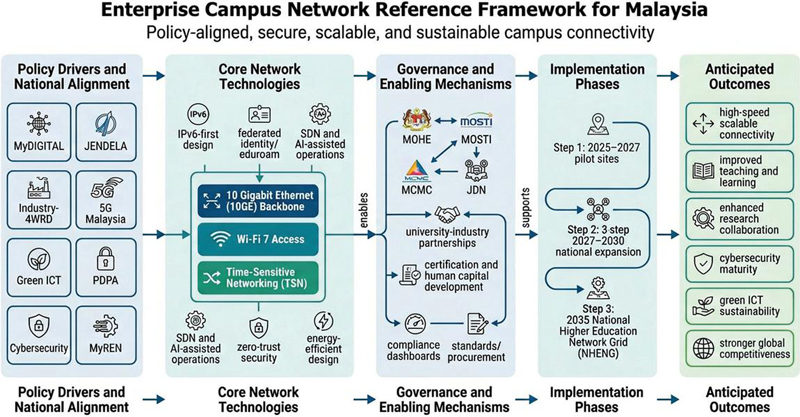
Cellular and fixed networks have quietly become the nervous system of modern universities and enterprises. Yet many so-called “campus networks” are still engineered as best-effort LANs rather than as strategic digital infrastructure. As research, teaching and administration increasingly depend on cloud, AI and real-time applications, the enterprise campus network (ECN) must be treated as critical infrastructure requirement, and not just as an IT project. The reference framework diagram above portrays the strategic journey for modernizing enterprise campus networks, balancing high-level policy mandates with concrete technical and operational requirements. For Campus Networks in Malaysia, it moves from foundational policy drivers such as MyDIGITAL and JENDELA, through to specific architectural imperatives like 10GE backbones, Wi-Fi 7, Enterprise 5G and Net5.5G, and IPv6 Enhanced and IPv6-First designs. By connecting these technologies to essential governance structures and through a phased, multi-year implementation plan, the framework provides a clear path toward achieving long-term outcomes. Among the desired outcomes include high-speed scalable connectivity, improved educational research collaboration, cybersecurity maturity, and green ICT sustainability, among others.
What we ask of future ECNs
In today’s environment, a production-grade, future-ready ECN is defined less by technical features and more by the experience it delivers. In practice, six requirements consistently emerge across universities, research institutes and large enterprises:
• High performance: predictable multi-gigabit throughput in the backbone and low latency to applications, even during peaks,
• Consistency: users experience the same quality of service whether they are in lecture halls, labs, hostels, or remote campuses, with uniform policies rather than ad hoc exceptions.
• Scalability: the network can grow from thousands to tens of thousands of endpoints, sensors and services without requiring disruptive redesigns every few years.
• Energy efficiency: each generation should lower watts per bit and favour designs that minimise over-provisioning, supporting national Net Zero and green ICT targets.
• Security: zero-trust principles, fine-grained segmentation and strong identity security underpin every connection, protecting both operational continuity and research assets.
• Privacy and isolation: policy-driven separation between student traffic, research flows, operational technology (OT) and guest access, aligned with data protection and sectoral regulations.
These requirements must be met simultaneously. It is no longer acceptable to trade security for convenience, or performance for energy savings; instead, the design challenge is to be optimised across all the six axes mentioned above.
Open and Future-Proof Technology Choices
The good news is that the technology building blocks for future-ready ECNs already exist and are mature. The question is how to combine them in ways that are cost-effective, open and backwards-compatible, while avoiding unnecessary vendor lock-in.
10 Gigabit Ethernet backbones. For most universities and large enterprises, 10 Gigabit Ethernet (10 GE) is now the practical minimum for core and distribution, with clear upgrade paths to 40/100 GE where research or intercampus flows demand it. Within Malaysia’s recent campus upgrades, which often see implementations of IPv6 Enhanced technology for addressing, backed by Enterprise 5G and Net5.5G designs for high speed end point infra, including fibre-to-the-room (FTTR) models delivering up to 2.5 Gbps per endpoint shows that such backbones and end connectivity are not just aspirational but well into implementation stages [1, 2].
Wi-Fi 7 as the campus edge. The transition from Wi-Fi 5/6 to Wi-Fi 7 (IEEE 802.11be) brings multi-link operation, 320 MHz channels and better deterministic behaviour which are critical for dense lecture halls, hybrid classrooms and AR/VR-based teaching. Malaysia is already piloting AI-optimised Wi-Fi 7 in public universities, and more than 13,000 access points have been deployed nationwide as part of a phased plan towards 32,000 Access Points [3, 4, 5].
Time-Sensitive Networking (TSN). TSN extends Ethernet with time synchronisation and scheduled traffic, enabling precise control for robotics labs, smart manufacturing testbeds and biomedical instrumentation. Early TSN pilots in research networks globally, and Malaysia’s own plans for testbeds at MIMOS and MRANTI, point to TSN as a key differentiator for research-intensive campuses [6, 7].
IPv6 Enhanced and IPv6-First, identity-aware networks. Campus networks that remain IPv4-centric will struggle to scale securely. An IPv6-first posture, combined with federated identity (such as eduroam/eduGAIN) and robust RADIUS/SAML integration, enables per-user and per-device policy, seamless roaming and cleaner segmentation across institutions [8, 9]. SRv6, Network Slicing, IFIT and IPSec are futuristic IPv6 features which will change the landscape.
Software-defined operations. Software-Defined Networking (SDN), streaming telemetry and AI-assisted operations are no longer optional “nice to have” features. An inherent feature within Enterprise 5G and Net5.5G technologies, they are essential for managing tens of thousands of endpoints, dynamically adjusting RF conditions, and spotting anomalies before they become outages. Malaysia’s first AI-powered Wi-Fi 7 deployments demonstrate how AI-O&M can reduce mean time to detect and repair while sustaining classroom SLAs [5, 10].
The unifying thread is openness: architectures should be grounded in global standards like IEEE, IETF and ISO, with clear interoperability across vendors. This is what makes an ECN future-proof, i.e. the fact that new generations of hardware or software can be introduced incrementally without redesigning the entire network.
Why Policy and Governance Matter as much as Technology
Even the best technical design will fail if it is implemented as a one-off project without proper policy backing. A national ECN framework provides the glue that aligns campus-level decisions with long-term public goals.
Malaysia’s Enterprise Campus Network Policy Guide situates campus networking squarely within national digital transformation agendas such as the Malaysia Digital Economy Blueprint (MyDIGITAL), JENDELA, Industry4WRD and 5G Malaysia [11, 12]. By defining strategic goals, target beneficiaries and expected outcomes, it positions universities as anchor nodes in a wider national digital fabric, not isolated IT islands.
Policy also ensures regulatory compliance by design. Personal data protection (PDPA), national cybersecurity guidance, spectrum allocation for Wi-Fi 7 in the 6 GHz band, and government cloud interoperability requirements all shape how ECNs can be architected and operated [7, 11, 13, 14]. Embedding these requirements early avoids a familiar pattern where technically successful pilots later hit legal or regulatory roadblocks.
Finally, governance clarifies who owns what. Lead ministries, regulators, research networks and campus CIOs each have defined roles in steering investment, setting minimum baselines (for example, 10GE-ready cores and Wi-Fi 7 in high-density zones), and monitoring performance through national dashboards [11, 15]. Without this shared governance, campuses may drift into fragmented procurement and inconsistent security implementations.
Malaysia’s Higher Education ECN Journey
Malaysia’s higher education sector offers a concrete example of how ECN principles translate into practice. The national research and education network (MYREN) already links universities, polytechnics and teaching hospitals, forming the backbone for high-speed academic traffic [16]. Recent policy efforts build on this foundation to standardise campus architectures and close gaps between early adopters and lagging institutions. It is also one of the first IPv6 only networks to be implemented in the world.
Wireless modernisation is one visible front. Government-funded programmes have deployed more than 13,000 access points (APs) across public university campuses, with a target of approximately 32,000 APs by 2027, and some campuses achieving 80–100% Wi-Fi coverage. [3, 4, 5] At Universiti Malaya, an AI-driven Wi-Fi 7 pilot demonstrates how multi-link implementations using 6 GHz spectrum and AIbased RF optimisation can sustain multi-gigabit performance in dense academic settings [5, 10].
Backbone upgrades are progressing in parallel. UPM Bintulu, for example, has implemented a CWDM-based FTTR design delivering 2.5 Gbps per endpoint, while research-intensive institutions such as Universiti Sains Malaysia are securing 100 Gbps international R&E links through partnerships like ARENA-PAC [1, 17]. These designs are explicitly engineered to scale towards TSN-enabled labs and high-throughput AI workloads [6, 17].
Smart classrooms and hybrid learning environments form the third pillar. At Universiti Teknologi Malaysia, smart classroom pilots integrate high-quality AV, edge compute, managed Wi-Fi and secure collaboration, showing how the ECN becomes the teaching and learning substrate rather than just a connectivity layer [18]. Similar initiatives across campuses support the Ministry’s projections that hybrid models will dominate by 2030, provided that network performance and reliability keep pace [19].
Together, these projects illustrate the ECN vision in action: a converged, high-performance fabric that supports research, teaching, operations and industry collaboration while remaining aligned with national policy and regulation.
What Really Works in Production ECNs
Across deployments and case studies, several patterns consistently separate successful ECN implementations from those that under-deliver.
• Architect for 10GE (and beyond) from day one: Even if initial traffic can be served on lower line rates, designing the core and distribution for dual-redundant 10 GE rings with clear upgrade paths avoids costly retrofits later [1, 11].
• Treat Wi-Fi 7 as a system, not just an access point. RF design, AI-assisted optimisation, identity integration and adequate wired backhaul must be planned together; otherwise, the wireless edge simply exposes backbone bottlenecks [3, 5, 10].
• Invest in people and operations: Certification programmes for campus network engineers, centralised NOCs/SOCs and shared playbooks are as important as hardware. Skills gaps in SDN, automation and TSN can quickly become the limiting factor [7, 11, 15].
• Standardise architectures and procurement: Common reference designs, RFP templates and security baselines reduce fragmentation across campuses and simplify federation via MYREN and eduroam [8, 9, 11, 15].
• Measure what matters: National dashboards that track uptime, latency, Wi-Fi health, TSN performance, security incidents and energy usage turn ECN performance into a visible, managed KPI rather than an invisible background service [15].
Equally important are the recurring pitfalls that often derail ECN ambitions:
• Fragmented, campus-by-campus procurement that prioritises short-term discounts over long-term interoperability, leading to incompatible management tools and duplicated effort.
• Designing purely for peak performance while ignoring energy and sustainability targets, resulting in over-provisioned, underutilised infrastructure that is politically and financially hard to defend [12, 20].
• Treating cybersecurity as an afterthought, bolted onto an otherwise completed network, rather than embedding zero-trust, segmentation and ISO/IEC 27001-aligned controls into the initial architecture [13, 14].
• Underestimating migration and user technology upgrades, especially for legacy OT, lab equipment and AV systems. This oversight can turn otherwise sound designs into disruptive projects that lose campus buy-in [6, 18].
• Piloting advanced features such as TSN or private 5G without first securing sufficient backbone capacity, spectrum coordination and operational readiness, leading to fragile proofs-of-concept that cannot be scaled [6, 7, 17].
Towards Trusted, Green and Intelligent Campus Fabrics
A future-ready enterprise campus network is not defined by a single technology generation. It is the result of deliberate choices: embracing open standards, designing for evolution, aligning with national policy, and investing in the people who will operate increasingly intelligent infrastructures.
Malaysia’s ECN journey in higher education shows that even in resource-constrained environments, it is possible to combine 10 GE backbones, Wi-Fi 7, TSN and AI-assisted operations into a coherent, policy-backed roadmap [1, 2, 3, 5, 6, 11].
As more countries confront similar challenges, the core lesson is simple: treat the campus network as critical infrastructure, and it will repay the investment in enterprise or research output, teaching quality, resilience and global competitiveness.
References
[1] UPMKB first Malaysia’s public university to adopt CWDM technology for network infrastructure – 17 Feb 2025. https://www.theborneopost.com/2025/02/17/upmkb-first-malaysias-public-university-to-adopt-cwdm-technology-for-network-infrastructure/.
[2] Malaysia Enterprise Campus Network Policy Guide 2025 – Executive Summary and Section 3.1.
[3] “Over 13,000 Wi-Fi access points installed at public universities nationwide: Fahmi” – 10 Jun 2025. https://newswav.com/article/over-13-000-wi-fi-access-points-installed-at-public-universities-nationwideA2506_JVvDht.
[4] “Over RM 600 million allocated to improve WiFi access at public universities” – 21 Jan 2025. https://www.bernama.com/en/news.php?id=2385115.
[5] “TP-Link to equip Universiti Malaya with Malaysia’s first AI Wi-Fi network” and related Wi-Fi 7 launch coverage – 17 Oct 2024. https://www.nst.com.my/business/corporate/2024/10/1121182/tp-link-equip-universiti-malaya-malaysias-first-ai-wi-fi-network.
[6] “Comprehensive Review on Time Sensitive Networks with a Special Focus on Its Applicability to Industrial Smart and Distributed Measurement Systems” – 19 Feb 2022. https://pmc.ncbi.nlm.nih.gov/articles/PMC8879530/.
[7] MIMOS Smart Manufacturing Intelligent Service Platform (SMISP) and MRANTI 5G Innovation National Testbed. https://www.mimos.my/portfolio/smart-manufacturing-intelligent-service/; https://www.mosti.gov.my/wp-content/uploads/2023/08/26-12-Jun-2023.pdf.
[8] eduroam hits a new record – 8.4 billion authentications in 2024 – Jan 2025. https://eduroam.org/eduroam-hits-a-new-record-8-4-billion-authentications-in-2024/.
[9] GÉANT Compendium 2023 and eduroam Support Organisations Status Report 2023–2024.
[10] UM launches Malaysia’s first AI-powered Wi-Fi 7 technology – 17 Oct 2024. https://www.businesstoday.com.my/2024/10/17/tp-link-empowers-um-with-first-ai-powered-wi-fi-7-inmalaysia/.
[11] Malaysia Digital Economy Blueprint (MyDIGITAL) and associated Enterprise Campus Network Policy recommendations.
[12] National Energy Policy 2022-2040 – Ministry of Economy, Malaysia. https://ekonomi.gov.my/sites/default/files/2022-09/National_Energy_Policy_2022-2040.pdf.
[13] CyberSecurity Malaysia principles and guidelines; MyCERT incident coordination resources. https://www.cybersecurity.my/.
[14] Government cloud services and interoperability guidelines (MyGovCloud, JDN). https://www.malaysia.gov.my/portal/content/31183.
[15] Malaysia Enterprise Campus Network Policy Guide – Governance and monitoring framework (Sections 5 and 8.3).
[16] MYREN – Malaysian Research & Education Network. https://www.myren.net.my/.
[17] “USM Partners with ARENA-PAC to Launch Malaysia’s 100 Gbps Research and Education Network” – 26 Sep 2024. https://soi.asia/usm-partners-with-arena-pac-to-launch-malaysias-100gbps-research-and-education-network/.
[18] “Universiti Teknologi Malaysia and Cisco redefine learning with smart classroom transformation” – 6 Feb 2024. https://www.digitalnewsasia.com/business/universiti-teknologi-malaysia-and-cisco-redefine-learning-smart-classroom-transformation.
[19] “Malaysia’s AI-Driven Education Landscape: Policies, Applications, and Comparative Insights for a Digital Future” – 2025. https://arxiv.org/html/2509.21858v1.
[20] Malaysia Enterprise Campus Network Policy Guide – Green ICT and sustainability sections (Sections 2.1.5, 7.4 and Annex 10.1).
Biographies
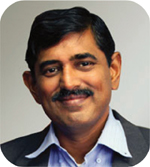
Sureswaran Ramadass is Head of Medical Informatics Department at RCSI & UCD Malaysia Campus (RUMC). He is also the Chairman of the APAC IPv6 Council, IPv6 Forum Academy and the IPv6 Forum Malaysia. He is also the Vice-Chair of NIDA and has supported ITU as a Subject Matter Expert (SME) in IPv6. He is also involved as an SME for IPv6 and Cybersecurity for MCMC, Malaysia. He has a distinguished career spanning next-generation networking, IPv6, cybersecurity and multimedia conferencing. He has led many IPv6 initiatives globally and numerous national and regional steering roles related to IPv6 deployment, education and certification. His academic highlights include being awarded the Tokoh Negara (National Laureate) for Innovation and commercialisation, the WWRF Fellow award and the National Innovation award by the Prime Minister (twice). He has graduated over 20 PhD students and awarded over USD 15 Million in numerous research grants.

Muhammad Asyraf Mohammad Naim is a digital transformation professional and technology strategist, and currently serves as Director for Training & Consultancy for IPv6 Forum Malaysia. He is a key contributor to IPv6 and 5G capacity-building initiatives in the region, and has helmed national and regional roles including the National IPv6-only Adoption Task Force Capacity Building Working Group and the MCMC NEXUS Application Validation. He has led projects spanning national-level IPv6 strategic roadmaps, sovereign digital infrastructure planning, policy analysis and development, and AI governance. His background combines technology strategizing, stakeholder engagement, and project leadership, with a portfolio of research and whitepapers in the domain of IPv6, 5G, Artificial Intelligence and data governance.

Vallikkannu Nagappan is Chief Secretary of the APAC IPv6 Council and a regional coordination and capacity-building professional with strong experience in IPv6 programme operations, stakeholder engagement and compliance support. In her current role, she manages council operations, coordinates regional meetings and partnerships, supports IPv6 audit and compliance assessments, and contributes to the development of best-practice frameworks that advance IPv6 adoption across the Asia Pacific. She holds qualifications in information technology and finance, and holds additional project management and IPv6 certifications, reflecting her blend of technical coordination, organisational leadership and training expertise.

Nor Ashidi Mat Isa is Professor at the School of Electrical and Electronic Engineering, and Chief Digital Officer at Universiti Sains Malaysia (USM), where he has served since 2003. His expertise covers artificial intelligence, intelligent systems, image processing, biomedical engineering, intelligent diagnostic systems, machine learning and algorithms, with research interests in medical diagnostic systems, image enhancement and reconstruction, neural network architectures, metaheuristic algorithms, segmentation, feature extraction, and intelligent clustering. He has published extensively in Web of Science-indexed journals, including papers in IEEE Access, Applied Soft Computing, Pattern Recognition, and Artificial Intelligence, and his work reflects longterm contributions to image analysis, medical imaging, and computational intelligence. Among his recent achievements include being recognised as the Top 2% Scientists for the Category of Citation Impact in Single Calendar Year 2019 & 2020 from Stanford University, as well as Top Research Scientists Malaysia (TRSM) from Akademi Sains Malaysia (ASM) in 2020.

Karen Morgan is President & CEO of RCSI & UCD Malaysia Campus (RUMC), one of Southeast Asia’s leading international medical universities. She is a Professor of Health Psychology and a Fellow and former President of the European Health Psychology Society. She holds a PhD in Health Psychology from RCSI, a Master’s in Social and Organisational Psychology from UCD, and a Postgraduate Certificate in Medical Education from Newcastle University. Before joining RUMC, she served as Director of Perdana University Royal College of Surgeons in Ireland School of Medicine (PU-RCSI) in Kuala Lumpur, and earlier worked as a change management consultant with Accenture on major government projects in the UK and Ireland. She is also a founding member of WomenEd Malaysia. With over 20 years of experience in health professions education, institutional quality assurance, and research capacity building, she brings institutional leadership perspectives on how future-ready digital infrastructure underpins research collaboration, hybrid learning, and organisational excellence in the higher education sector.